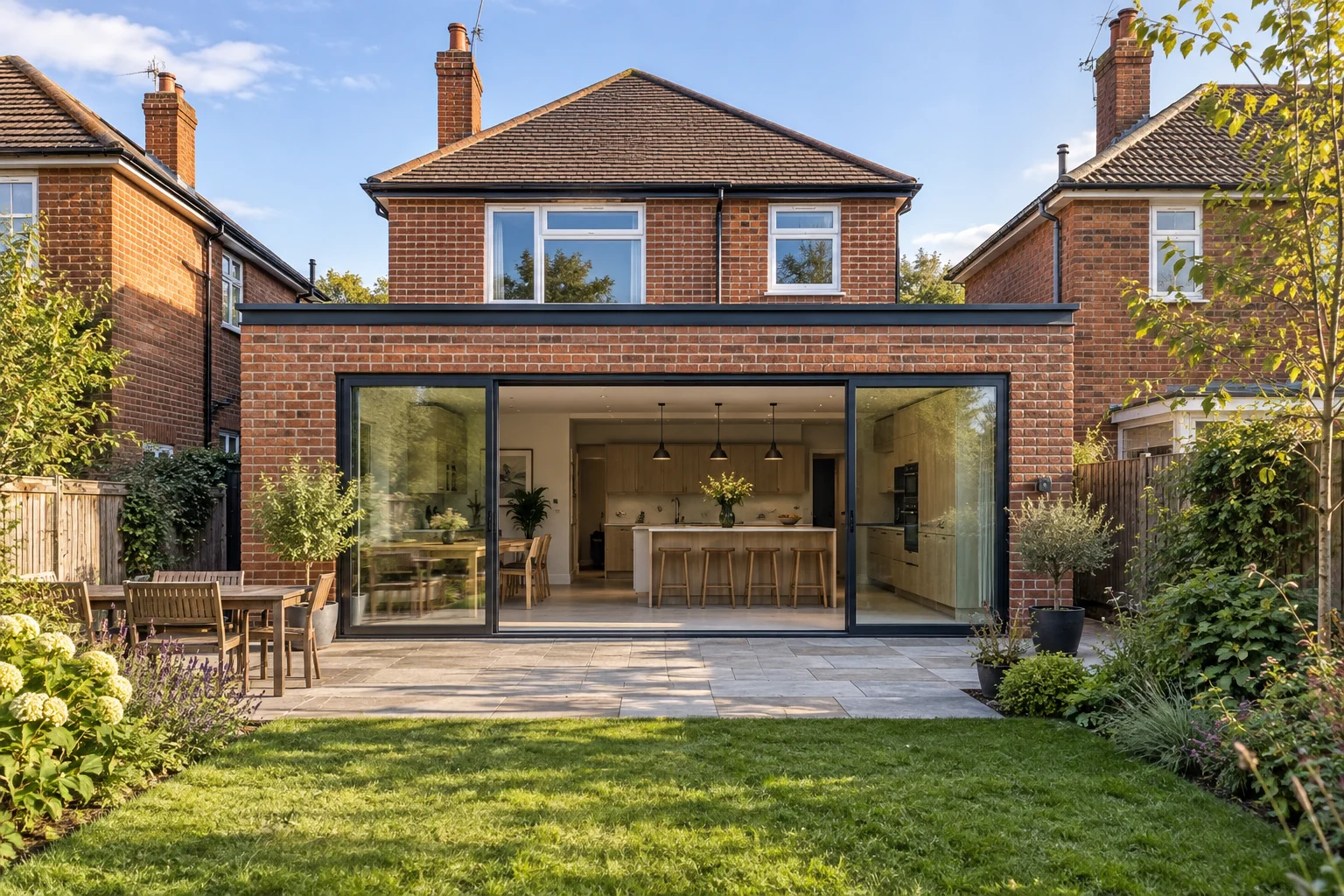
Architectural concept · not a completed company project
LAYOUTS · DRAWINGS · DESIGN COORDINATION
Architectural design for Nottingham home projects
Turn the way you want to use your building into a defined design brief. Discuss layout options, drawing deliverables and specialist coordination with Design N Build for your property and project stage.
Prefer to send your project details?OUR PROCESS
How your design commission develops
Start with a conversation. Agree the scope, responsibilities and timing before the next stage begins.
Talk through your project01. Explain the use
Describe the people, activities and features to retain.
02. Establish the base
Identify survey coverage, existing records and uncertainties.
03. Develop the proposal
Agree the options, drawing outputs and specialist interfaces.
04. Control the issue
Review feedback and record each drawing’s intended purpose.
YOUR QUESTIONS
Frequently asked questions
From the first conversation to the agreed building work, here are some useful things to know.
Ask us on WhatsAppHow do I choose between a layout study and a technical drawing appointment?
Choose the scope according to the decision still unresolved. A layout study explores how the building should work; technical development defines an agreed arrangement and its interfaces. Explain whether you are comparing options or preparing for construction pricing. The appointment should identify the appropriate output rather than giving an undeveloped idea a construction label.
Does this page mean Design N Build employs an ARB-registered architect?
No claim about an individual’s registration is made here. The protected title architect requires registration, while architectural services describe a broader service activity. Ask who will undertake your commission and request the relevant evidence. If an architect is required, verify the named individual through the Architects Register before relying on that status.
What should I write in an architectural design brief?
Describe the activities the building must support, features you want to retain and problems you need to resolve. Identify essential outcomes, preferences and uncertain choices separately. Include users, furniture or equipment requirements where relevant. A brief explains why a change matters so the design can be assessed against your priorities.
Are estate-agent floor plans a sufficient survey base?
They may provide useful background but should not be assumed accurate or detailed enough for the commission. Explain their source and any known alterations. Discuss the measured information required for the proposal, including levels or roof geometry where relevant. The design basis should state which features have been verified and which remain uncertain.
Can you develop a design from an inspiration photograph?
A photograph can communicate appearance or a room relationship, but it does not describe your site, dimensions or technical conditions. Explain what you like about it and provide information about your building. The resulting proposal needs its own assessment rather than copying an image and assuming the same solution will work.
Why are sections useful when the floor plan looks straightforward?
Sections reveal heights, roof slopes, floor relationships and other vertical constraints that plans can conceal. They can show whether a proposed room or stair arrangement is actually understandable in three dimensions. Ask for the views needed to judge the relevant issue, with provisional measurements identified instead of treating every drawn relationship as verified.
More project questions 14 answers
How many initial design options will I receive?
The number and scope should be agreed in the proposal. Explain which alternatives you want to compare and what decision they should help resolve. A controlled option set is more useful than unlimited variations without evaluation criteria. Further exploration after priorities change may require an adjusted appointment and programme.
Can a larger room still fail to solve my layout problem?
Yes. Furniture, routes, privacy and the relationship with retained rooms can limit usefulness even when floor area increases. Describe the activities and conflicts behind the brief. Evaluate options using those outcomes, including effects elsewhere in the building, rather than treating additional square metres as the only measure of success.
Will architectural drawings include structural calculations?
Only if a defined structural appointment is included and appropriately undertaken; it should not be inferred from the drawings service alone. Structural design and architectural arrangement need coordination but are different responsibilities. Ask who provides the assessment, how its information is incorporated and which interfaces remain unresolved before issue.
Are planning drawings ready for a contractor to build from?
They often serve a different purpose and may lack construction details or specialist coordination. Ask which information is needed for the intended pricing or building stage. Keep issue status clear so a planning set is not mistaken for a complete construction package simply because it has been submitted or approved.
Can you guarantee that my planning application will be approved?
No. The relevant authority determines applications under the applicable process. Design information can support a proposal, but the appointment must identify requirements and limitations for the actual property. Discuss constraints and the chosen route with the appropriate adviser; do not treat a nearby approval or an attractive drawing as a guarantee.
Is the same approval advice valid everywhere in the UK?
No. Establish the jurisdiction and authority for the site and use its relevant requirements. Nottingham-focused examples do not establish procedures for Scotland, Wales or Northern Ireland. Send the actual address so the design scope and specialist input can be considered in the correct context before submissions are planned.
Who handles additional information requested by the planning authority?
That should be stated in the appointment, including any revision or additional-fee arrangements. Some requests may require a separately appointed specialist. Keep correspondence and drawing revisions recorded. The client should understand which response tasks belong to the design service and which require another commission or decision.
How should kitchen or glazing supplier drawings enter the design set?
Agree when the supplier provides information and who coordinates dimensions, interfaces and performance requirements. Identify which surrounding details depend on the package. A supplier drawing should not be treated as an isolated purchase document if it changes the building arrangement. Resolve queries through the named design and supplier responsibilities.
Does architectural design include all interior colour and finish selections?
Not automatically. Define the level of interior and specification work you need, including lighting, joinery or finish schedules where appropriate. Client selections and another designer’s input can also be coordinated. The appointment should make those boundaries explicit and identify information needed from items purchased outside the design service.
How can cost advice help before I settle on one proposal?
An appropriately scoped estimate can compare defined options using stated assumptions. The design and cost documents must refer to the same scheme and information set. Ask how affordability will be reviewed and what uncertainties remain. A visualisation alone is not evidence that an option has a confirmed construction price.
What if different family members send conflicting design comments?
Agree a client decision maker and consolidate feedback before the next issue. Record disagreements that remain unresolved instead of asking the designer to infer an instruction. Refer comments to drawing numbers and desired outcomes. This creates a reliable brief while still allowing everyone’s priorities to be considered openly.
Will the designer attend site throughout the building work?
Only where defined in the appointment. Clarify visit frequency, purpose, query responses and any separate contract duties. Design support, statutory inspections and contractor management are different roles. Do not assume that a site visit transfers responsibility for every aspect of construction or provides certification beyond the agreed professional role.
Do completed design drawings prove the exact building was constructed?
No. A design record and a verified as-built record have different evidence bases. If you need measured completion information, identify the survey and verification scope. Label final documents accurately and record changes where agreed. The archive should explain what each file represents rather than implying checks that were never undertaken.
How do I request an architectural design proposal from Design N Build?
Call or WhatsApp the property address, intended change, project stage and available plans. Explain the next decision and any professional requirements. A proposal should set out deliverables, revisions, dependencies and exclusions for that purpose. The conversation can then focus on the design work you actually need instead of commissioning a generic drawing bundle.
Commission architectural design for a defined outcome
Tell us what the drawings need to help you do
Discuss architectural design with Design N Build when a building idea needs to become an understandable, coordinated proposal. You may be exploring a new layout, preparing an application or developing information for construction. State which of those outcomes you need next. A commission to explore possibilities differs from a commission to detail an agreed scheme. Naming the deliverable at the beginning helps you compare appointments without assuming that every drawing service includes the entire route to a completed building.
For a homeowner, the design brief might concern a kitchen that no longer suits family life, an awkward connection to the garden or an additional room within the existing structure. A commercial client might need a layout that separates public and staff areas or accommodates equipment within a refurbishment. These are functional questions before they are drawing tasks. Describe the people, activities and constraints so that the design discussion addresses the building’s use rather than simply reproducing an image you like.
Design N Build has a Nottingham base and takes enquiries for residential, commercial and wider UK projects. Send the actual site address and project stage to discuss the appropriate appointment. Coverage does not establish the approval requirements for a particular address, and an initial conversation does not determine structural feasibility. The proposed service should identify the information it will produce, the decisions you will need to make and the specialist inputs it relies upon.
Clarify the people and responsibilities behind the proposal
Ask who will lead the design work, what relevant evidence they can provide and which disciplines are separately appointed. The title architect is protected in the UK and may only be used by an individual on the Architects Register. Architectural services and the protected title are different matters. This page describes the service enquiry; it does not claim that any named member of Design N Build is an ARB-registered architect. If your appointment requires an architect, verify the individual and responsibilities before proceeding.
Define who handles surveys, structural design, services design, specialist assessments and submissions. If someone already works for you, supply their appointment scope rather than assuming they will be replaced. Agree the coordinator for information passing between parties. A clear design appointment can include dependencies and exclusions while still providing a coherent next step for the customer. It should not leave important work assigned only to an unnamed someone later.
Official reference: Architects Registration Board: the protected title architect
Turn household and business activities into a usable brief
Describe a normal day before choosing a room arrangement
A list of room names does not explain how the building must work. For a family kitchen, describe cooking, eating, homework, visitors and movement to outdoor space. Identify which activities occur together and which need separation. For a home office, explain calls, concentration, storage and access without interrupting other rooms. These details can reveal why a larger room alone may not solve the problem. The first design conversation should distinguish an area shortage from a circulation, privacy or arrangement problem.
Record what works well in the current building. You may want to keep morning light, a quiet bedroom position, a useful store or a direct route from the entrance. Mark those features as retention priorities. Design options should then show the trade-offs involved in changing them. Without that record, a proposal can improve one room while unintentionally removing something valuable elsewhere. The brief should include the building you want to keep as well as the work you want to add.
Commercial users should describe people and operations with equal care. Where do visitors arrive, where are deliveries received, and which staff tasks need privacy or proximity? Identify any equipment or fixtures whose dimensions and service needs are known. Provide the applicable specialist requirements rather than asking the layout designer to invent them. A premises brief becomes useful when it relates spaces to activities and responsibilities, with operational decisions recorded by the client.
Distinguish requirements, preferences and open questions
Separate outcomes that are essential from features you would like to explore. A required accessible route, a particular equipment footprint and an aesthetic preference do not have the same decision status. Give each requirement a reason and, where available, its evidence. This lets alternatives be evaluated against the brief rather than judged only by how attractive a perspective appears. It also helps identify where specialist advice is needed before a requirement can be stated confidently.
Maintain an open-questions list alongside the brief. You might be uncertain about whether to extend or reorganise, whether to retain a staircase, or how much supplier selection belongs in the design stage. Those uncertainties should be addressed openly. The appointment can include a defined option exercise to resolve them instead of quietly treating one tentative suggestion as the final instruction.
Establish what the existing building actually contains
Choose survey information appropriate to the proposal
Existing drawings are useful only when their reliability and coverage are understood. A previous estate-agent plan, a historic application drawing and a measured survey have different purposes. Identify their source and date, and say whether later alterations have occurred. Do not assume that a plan downloaded from a planning record accurately describes everything now on site. The design team needs a reliable base or a clear account of the checks required to establish one.
Agree the scope of any measured survey. Room dimensions alone may not provide roof geometry, opening positions, changes in level or external context needed for the proposed work. Conversely, not every commission needs the same level of survey detail. Explain the intended design and discuss which measurements, photographs and records are necessary. Survey coverage should relate to the decision being made, with inaccessible areas and limitations documented rather than guessed.
A measured drawing does not certify hidden structure, services, condition or a legal boundary. If the proposal depends on those matters, identify the relevant investigation and professional advice. A line that appears straight on a base plan is not evidence of ownership or permission to build along it. Bring deeds, existing reports and known issues to the conversation so that design assumptions can be separated from facts requiring further verification.
Locate uncertainty before it becomes a polished image
Show uncertain features on the working record. An unverified drain position, concealed beam or unclear roof junction may affect an option even though it is not prominent in a visualisation. Name the issue and the information required to resolve it. This gives the client a realistic view of what an option can demonstrate and what still depends on assessment. Presentation quality should not create an impression that the existing building has been fully investigated.
Photographs should describe context safely: the relationship between rooms, external elevations, access and visible features. Avoid photographs taken from unsafe positions or destructive checks performed without suitable arrangements. Share relevant records with permission and explain any missing coverage. An orderly existing-information set reduces avoidable redesign and helps the next drawing issue represent the actual property more reliably.
Evaluate spatial options before refining the appearance
Test movement, furniture and relationships together
Review floor plans with realistic furniture and activity zones. A room may look generous when empty yet become awkward once a table, storage and circulation routes are included. Indicate door swings, frequently used routes and places where people need to pass one another. For an extension, examine the adjoining original rooms too. If a new kitchen leaves the former kitchen without a clear role, that area belongs in the layout discussion rather than being ignored outside the new footprint.
Consider how different users move through the proposal. A route to a bathroom should not be assessed only as a line on a plan if it interrupts a private workspace or passes through a room used for sleeping. Discuss privacy and supervision where they matter to the household. For a commercial layout, distinguish customer movement from deliveries or staff tasks where the brief requires it. These relationships provide substantive criteria for choosing between options.
Use sections as well as plans where height and level changes matter. A stair, roof slope, raised threshold or ceiling arrangement can determine whether the intended room feels useful. A plan can conceal those constraints. Ask for the views needed to understand the proposal, and identify which dimensions remain provisional. The design exercise should make difficult interfaces visible while there is still an opportunity to reconsider them.
Compare alternatives against the same priorities
Give each option a clear identity and record how it addresses the brief. A larger footprint might improve dining space but reduce outdoor space or complicate access. An internal rearrangement may preserve the garden while accepting a different room relationship. State these trade-offs openly. The objective is an informed selection, not a presentation in which every alternative appears to provide every benefit without consequences.
Agree the scope and number of options in the appointment. Retain the chosen option and note why the others were not pursued. If your priorities change, identify that as a new decision instead of confusing it with correction of an error. This record helps subsequent design work develop an agreed direction and protects the usefulness of earlier conversations when several household members or business stakeholders are involved.
Examine openings, daylight and external relationships
Discuss the room experience behind glazing choices
An opening affects more than the appearance of an elevation. Its position can influence furniture placement, privacy, views, daylight and the connection between internal and external spaces. Describe what you want the room to feel like at the times you expect to use it. Explain any concerns about overlooked areas or glare. Avoid selecting glazing solely from a reference photograph without considering the orientation, neighbouring context and intended activities of your own building.
Large glazing and rooflights require coordination with structure, roof arrangement and environmental design. The architectural proposal should identify relevant dependencies and seek the appropriate technical input. It should not promise a particular temperature, energy bill or daylight outcome without a supporting assessment. Where performance matters to the choice, discuss what analysis is needed and who will provide it. An attractive image can initiate the conversation but cannot verify performance.
Consider the transition outside. Door positions, steps, thresholds, drainage interfaces and the intended ground levels belong in the design discussion. A drawing of a garden-facing elevation does not automatically define the finished terrace or access route. Clarify whether external layout work is included in the appointment and how it relates to retained landscaping. This helps prevent an apparent indoor solution from creating an unresolved practical problem at the threshold.
Understand neighbouring context without inventing rights
Bring information about adjacent buildings and the site’s actual boundaries where relevant. A nearby extension can be useful context, but it does not establish that your proposal will receive permission or that the same dimensions are suitable. Discuss which contextual drawings or assessments are needed for the intended application. Avoid treating a street photograph as a complete account of ownership, consent or neighbouring effects.
If work may affect adjoining property, identify the need for appropriate advice early. The architectural commission should state its role and any separate appointment required. It should not imply that a design drawing grants access, settles a boundary dispute or fulfils every party-wall responsibility. Clear boundaries between design information and legal or specialist advice make the project easier to plan responsibly.
Order a planning package with an explicit submission scope
Confirm the authority and the actual application route
For Nottingham and nearby projects, use the exact property address to establish the relevant local authority. A postal description is not enough to identify every planning responsibility. For other UK locations, obtain the guidance for the property’s jurisdiction. The application route, local requirements and constraints must be checked for the proposed development. This guide does not apply England’s procedures indiscriminately to Scotland, Wales or Northern Ireland.
In England, planning permission and building-regulations approval are separate checks. Whether an application is required depends on the actual building and proposal. Discuss this with the appropriate adviser and authority before assuming an extension or alteration is exempt. A design commission can help prepare information for a chosen route, but it does not guarantee approval or replace the authority’s decision.
Where an application is needed, agree who will prepare and submit it and who will manage correspondence. Required supporting material can include national and local requirements specific to the application. Establish what belongs in the appointment and what must come from another specialist. A planning-drawing fee should not be assumed to contain every survey, statement or assessment the authority might need for the property.
Follow the decision and its conditions through design
An application submission is a defined milestone, not necessarily the end of design work. If the authority requests additional information, establish how that work is handled. If the proposal changes during assessment, ensure the revised drawings and supporting information remain consistent. Record submission references and issued revisions so that the client can see which scheme is under consideration.
When a decision is issued, review the approved documents and any conditions with the appropriate adviser. Identify further information or action required before relevant work proceeds. Do not assume that a later product substitution or layout change is covered by the earlier approval. The design record needs to connect the approved proposal with subsequent technical development, identifying differences that require consideration rather than silently absorbing them into new drawings.
Official reference: Planning Portal: application supporting information
Official reference: GOV.UK: building-regulations approval and separate planning checks
Develop technical information that connects the disciplines
Move from arrangement to defined building interfaces
Technical development explains how the agreed proposal relates to the building’s components and specialist designs. Plans, sections, junction details and schedules may be needed depending on the project. Agree the output list and level of information rather than ordering construction drawings as an undefined bundle. A useful proposal describes the parts to be developed and the dependencies that could limit an issue.
Structural input must be coordinated with architectural arrangements. An opening, stair location or roof form can require a structural solution whose dimensions affect the layout. Where a member or support arrangement changes, identify whether architectural drawings need updating. The structural designer’s work is not complete merely because a steel element is shown symbolically on an architectural plan, and an architectural drawing should not be presented as a structural calculation.
Building services also occupy space. Ventilation routes, drainage, heating equipment and electrical arrangements can influence ceilings, cupboards and plant access. Obtain relevant specialist information before fixing an arrangement that leaves no practical route or maintenance access. The coordinator should identify clashes and questions, not assume every concealed service can fit wherever a visualisation shows a clean surface.
Assign design decisions that are delegated to suppliers
Glazing, kitchen systems, specialist stairs or other packages may include supplier design. Identify the supplier’s required inputs and the point at which its information must be coordinated. Explain who checks dimensions, performance requirements and interfaces. A note saying by specialist does not allocate all the communication needed to make the package work with the surrounding construction.
For building-regulations information, establish the relevant process and professional responsibilities for the actual project. Higher-risk or specialist buildings can involve additional requirements and should not be treated as standard homeowner alterations. A design appointment must reflect that context. Ask for the proposed roles and evidence rather than assuming a generic drawing package fulfils every statutory duty or technical assessment.

Use materials and details to make a coherent specification
Choose finishes with their surroundings in mind
Materials need to be considered as part of an assembly and room arrangement. A finish choice can change thicknesses, junctions, preparation and maintenance access. For an existing home, examine how new work meets retained floors, walls and external materials. Discuss whether the intention is a close match or a deliberate contrast, and what evidence is available to judge it. An image on a screen may not establish colour, texture or suitability in the actual setting.
Create a schedule for decisions that require samples or supplier information. Record the product reference, intended location and approval status. Where a product has not been selected, state the required performance and appearance criteria so that the next stage is not built around an unspecified assumption. If a substitution is proposed, assess the affected details instead of treating similar appearance as proof of equivalence.
For commercial premises, specialist requirements may shape the specification alongside visual choices. Cleaning, wear, operational use and equipment interfaces can matter to the client’s brief. Provide the relevant requirements and identify the competent specialist where assessment is needed. Do not infer compliance from a marketing description or choose a finish purely because it appears in another building photograph.
Make the extent of finish design clear
Clarify whether the appointment includes colour selection, lighting layout, bespoke joinery or detailed interior design. Architectural arrangement and full interior specification are related but distinct commissions. A client can select finishes directly, appoint another designer or include defined elements in the architectural scope. The important point is that the boundary is understood and the resulting information is coordinated.
Record what remains outside the specification. Loose furniture, appliances, landscaping or decorative accessories may be client purchases, but some still affect the building design. Provide critical dimensions and connection requirements in time. A clear exclusion should not conceal a dependency: the designer may not supply an item, yet still need its information to define the surrounding space.
Connect design development with an affordable scheme
Review cost consequences before decisions are fixed
Share the available budget context and identify what it includes. The design discussion should distinguish a construction allowance from a wider amount covering fees, purchases and other expenditure. You do not need a finished tender bill to identify affordability as a priority. You do need to explain the basis of the budget so that the design team understands what decision it is supporting.
If early options require cost advice, agree the appropriate estimation appointment and information exchange. A visual option is not a priced offer. A cost adviser needs a defined scope, assumptions and source set to assess it meaningfully. The architectural and cost records should refer to the same option so that the client does not choose a layout using a total calculated for an earlier arrangement.
Where a proposal is adjusted for affordability, record what has changed in the user outcome, specification and interfaces. Reducing a footprint, simplifying a roof and changing a finish are different design decisions. Explain their consequences rather than presenting all of them as interchangeable savings. Required performance and technical suitability need appropriate consideration; budget pressure alone cannot justify an unsuitable detail.
Decide what to resolve before inviting construction prices
Ask whether the scheme is sufficiently defined for the intended pricing exercise. Contractors can make differing assumptions when drawings lack finish schedules or coordinated specialist information. If the purpose is a developed quotation, identify the outstanding matters that prevent comparable offers. If the purpose is an earlier budget enquiry, say so and document the uncertainty instead of calling it a complete construction tender.
Coordinate design information with any bill or pricing schedule. When a drawing changes, check whether quantities or descriptions need amendment. A tender package assembled from mismatched revisions can create commercial confusion even when each file appears professional. Use one controlled issue set and allocate responsibility for keeping architectural, specialist and cost documents aligned.
Manage drawing issues and client feedback deliberately
Give comments a clear route into the next issue
Agree who can approve design decisions on the client’s behalf. Several household members or business stakeholders may contribute, but conflicting instructions need a resolution process. Consolidate feedback and identify the decision maker rather than asking the designer to infer a compromise from separate messages. Keep unresolved disagreements visible so that a new issue is not mistaken for a fully accepted scheme.
Use drawing references when commenting. A marked-up plan with numbered notes can be easier to interpret than a long message describing left and right without a view reference. Explain the desired outcome as well as the proposed solution. If you suggest moving a doorway because circulation is awkward, the designer can assess that underlying problem even if the exact move would create another conflict.
Discuss revision allowances in the proposal. An agreed number of development rounds can support a productive option exercise; repeated changes after a selected scheme may require further work. Clarify what is treated as a correction, what is a development decision and what changes the commission. This is a service-scope matter, not a reason to discourage questions before the client understands the design.
Identify each document’s purpose and status
Each issue should state what it is for and the information it replaces. A drawing used for option discussion should not circulate as an instruction to build. A planning issue may not contain technical detail needed for construction. Keep the register and title information clear enough that other participants can identify the relevant set without relying on a filename remembered from a message.
If drawings are shared with a contractor or supplier, establish who sends the controlled set and how queries are answered. Retain a record of superseded information and communicate significant revisions to affected parties. Design coordination becomes more reliable when everyone can identify the same current information and understand what remains subject to development or specialist confirmation.
Agree what design support continues into construction
Define responses, reviews and site involvement
Construction can raise questions about details, existing conditions or supplier coordination. State whether the appointment includes answering such queries and how that support will be provided. A design service ending at drawing issue should not be assumed to include unlimited visits or contract administration. Conversely, if you require continuing involvement, name the activities and expected arrangements in the proposal rather than relying on a broad phrase such as full service.
Clarify the purpose of any site visit. Design review, inspection, progress observation and formal contract duties are different roles. Identify who is responsible for contractor management, workmanship, technical certification and statutory inspections under the actual appointments. The design team’s presence at a site does not automatically transfer those obligations. Ask for a written account of the relevant role so that reliance is appropriate.
When an existing condition differs from the assumed design basis, record the observation and seek the necessary assessment. A change should be coordinated with affected disciplines and any approval implications before it becomes an instruction. Avoid treating a quick verbal solution as a complete replacement for relevant drawings, calculations or supplier information. The appropriate response depends on the issue and the authority of the people appointed.
Decide how completion information will be assembled
Establish whether updated drawings, schedules or a record of changes form part of the design commission. A final issue should be labelled accurately: an updated design drawing is not necessarily a verified record of everything built. If a measured as-built record is needed, discuss its survey and verification requirements separately. This avoids making the archive appear more authoritative than the evidence supports.
Identify who will collect product information, specialist records and approval documents relevant to completion. The design service may contribute particular files without owning the entire handover process. Agree that boundary early. An understandable completion record helps the client manage future alterations and maintenance, but it should reflect actual deliverables and evidence rather than invented certification.
Arrange your architectural design enquiry
Prepare the material that explains your starting point
Send your property address, current use and the change you want the building to support. Include available plans and explain their source. Photograph the rooms and external relationships safely, then describe your priorities in a short brief. If you already have an adviser or approved scheme, provide the relevant documents and appointment boundaries. This allows a conversation about the missing design work rather than duplicating a completed commission.
State the next milestone you are trying to reach: comparing layouts, deciding whether to proceed, preparing an application or defining work for construction. Identify any deadline and its reason. A preferred date can be discussed, but design, survey, specialist and authority dependencies need assessment before a programme is agreed. Do not assume a guaranteed application outcome or turnaround from the service title.
Tell us which deliverables you expect and what remains undecided. If you need an ARB-registered architect, independent professional advice or a particular specialist capability, say so at enquiry stage. Relevant evidence and the actual appointment must be established for your project. The first conversation should make those needs visible without inventing credentials or assuming every discipline is included.
Request a proposal you can compare confidently
A useful proposal names the stages, drawing outputs, options, review arrangements and specialist dependencies. It explains what the client supplies, what the design service undertakes and what is excluded. Ask how submissions, further information requests and construction-stage support are handled. Comparing these boundaries gives more insight than comparing a single design-fee figure without its deliverables.
Call Design N Build to talk through the building problem, or WhatsApp your address, priorities and available drawings. The next step is to agree a suitable design scope and the information needed to begin. Architectural design can help turn an idea into a coordinated proposal; construction, statutory decisions and specialist appointments retain their own defined responsibilities throughout the project.
Agree how architectural options will be compared
Specify the decision document you want to receive
When commissioning options, ask for a clear record of the question each option answers. One arrangement might prioritise retaining an existing room; another may explore added accommodation or a different circulation route. Record the household priorities used to compare them and the assumptions still requiring investigation. A set of attractive images is not the same output as a coordinated option assessment. Agree what plans, explanatory notes and limitations will be supplied, who can review them and how comments will be collected before the next stage of the appointment is accepted.
If one option is selected, identify which decisions carry forward and which remain open. Cabinet positions, structural geometry and approval implications may require further work even when the household prefers a layout. Keep the accepted option reference with subsequent drawing revisions, and ask how departures from it will be communicated. This gives you a practical way to track the design purchase: the project moves from a stated question to a documented choice, then to separately defined development work. It also helps prevent a contractor pricing a discarded concept while the client assumes the latest arrangement has been adopted.
LET’S DISCUSS YOUR BUILDING DESIGN
Make the next drawing serve your project.
Call with your design priorities, or send the property location and existing plans on WhatsApp. Discuss the drawing scope and any specialist appointments you need.