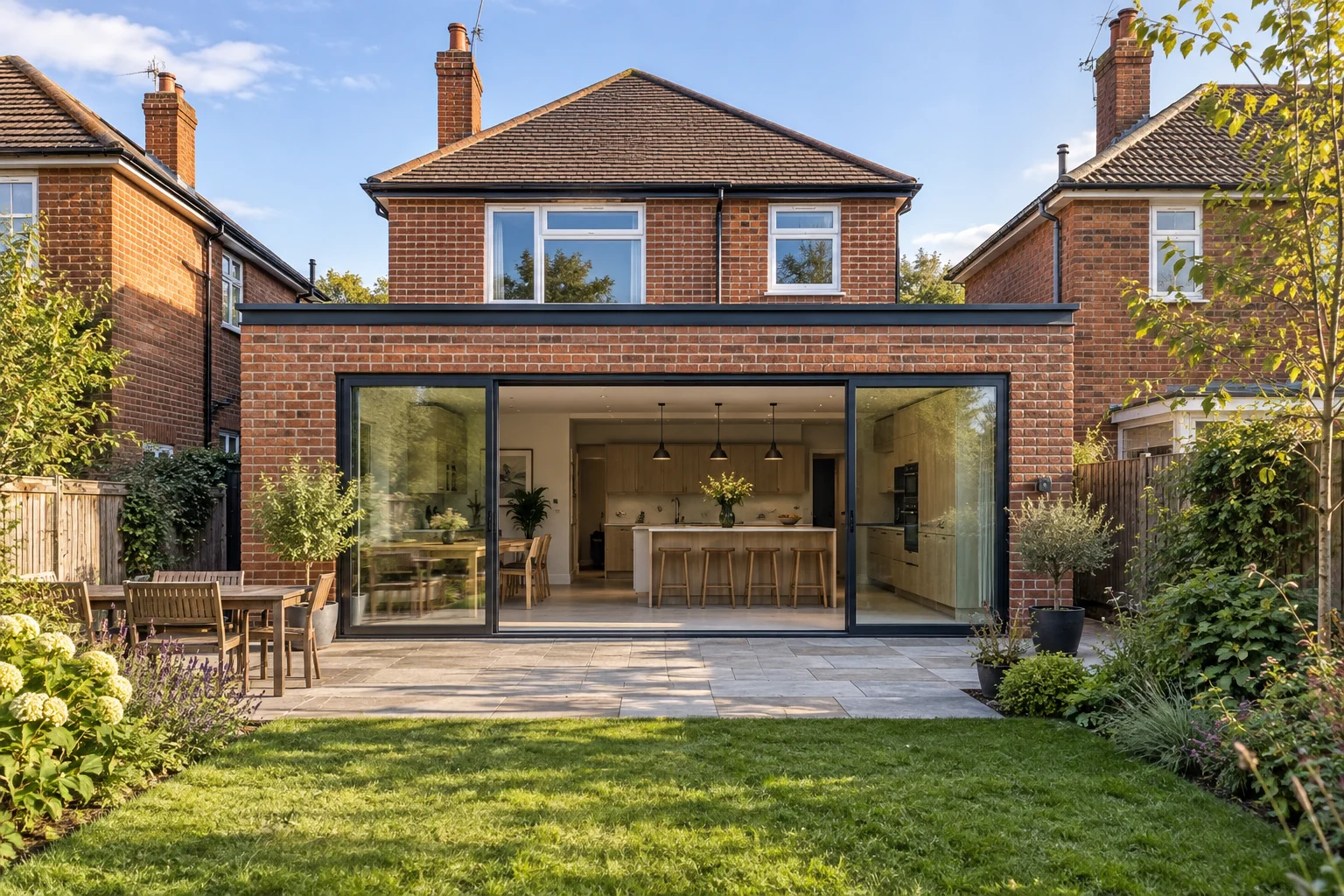
Architectural concept · not a completed company project
NOTTINGHAM · RESIDENTIAL DESIGN AND BUILD
Residential design and build in Nottingham
Join the decisions about your home with the building package needed to deliver them. Discuss your brief, existing advisers and project stage, then define the actual scope of each appointment.
Prefer to send your project details?OUR PROCESS
How your home project
takes shape
Start with a conversation. Agree the scope, responsibilities and timing before the next stage begins.
Talk through your project01. Consultation
Share your postcode, priorities, photographs and any drawings.
02. Design & scope
Discuss the layout, specification and information needed to price the work.
03. Build planning
Agree the construction package, appointment terms and programme.
04. Completion
Review the agreed work, outstanding items and relevant handover records.
YOUR QUESTIONS
Frequently asked questions
From the first conversation to the agreed building work, here are some useful things to know.
Ask us on WhatsAppWhat should a residential design-and-build appointment define?
It should state the work and design responsibilities being appointed, the outputs required and the completion boundary. Identify separate professional inputs and exclusions. The phrase design and build does not by itself establish who prepares every drawing or accepts every project responsibility.
Can I start with ideas rather than completed plans?
Explain the household problem, property and priorities at the first conversation. An early brief can identify information and decisions needed for the next stage. Confirm the scope and terms of any design appointment before assuming the initial enquiry includes drawings or professional advice.
What if I already have an architect or designer?
Share the current drawings and explain the existing appointment. Identify which responsibilities remain with that designer and what work you want Design N Build to discuss. Coordination is clearer when the construction package and retained design roles are recorded explicitly.
How should a homeowner brief be organised?
List desired rooms, everyday activities, retained features, budget priorities and occupancy needs. Separate essentials from preferences. Include existing information and unresolved questions so the team can understand whether the next decision concerns feasibility, layout development or construction pricing.
What should be agreed before design work is commissioned?
Clarify the deliverables, drawing stages, revisions, fees and responsible people. Identify surveys, structural design, applications and other specialist work that may sit outside the appointment. Ask how additional work is authorised if the brief changes after the initial scope is agreed.
How are design decisions connected to the construction budget?
Review the design against the defined specification and current cost assumptions at agreed points. Mark allowances and unresolved items clearly. A layout change, glazing choice or new room can affect connected work, so assess the whole consequence before treating an option as a simple upgrade.
More project questions 14 answers
Who makes planning or building-control applications?
Name the party responsible for preparing, submitting and coordinating each relevant application or approval process. Confirm what the appointment includes and which fees remain separate. Do not assume those tasks transfer to the builder solely because construction is part of the project.
How should structural engineering be coordinated?
Identify the appointed structural designer, required information and responsibility for incorporating it into the construction documents. Agree who answers queries and issues revisions. Architectural layouts and structural details need a consistent current version before the affected work is priced or built.
Can a design-and-build project use client-supplied fittings?
Yes, discuss the intended items when defining responsibilities. Agree specification checks, measurement, delivery, storage, installation and defect handling. Client supply changes coordination requirements, so the appointment should describe those interfaces rather than simply excluding the purchase price.
What does a construction-ready information package contain?
The necessary content depends on the work, but should define the build, relevant technical details, specifications and responsibilities sufficiently for the package being appointed. Ask for outstanding decisions and assumptions to be listed. Planning drawings alone may leave important construction information unresolved.
How should design changes be recorded during building?
Use the agreed change process to identify the revision, reason and effect on price, programme and other work. Confirm who can authorise it. Messages and sketches can support discussion, but important changes should be captured in a clear project record.
Can design and construction be appointed in separate stages?
Discuss the scope, terms and decision point for each stage. An initial design appointment need not imply that construction has already been commissioned. Clarify what information the client receives and what further agreement is required before a building package proceeds.
How do I compare design-and-build proposals?
Compare responsibilities, deliverables, design stages, construction scope, allowances and exclusions alongside price. Identify separate fees and specialist appointments. Two proposals with the same label may cover very different work, so ask each provider to explain the package against the same brief.
Who coordinates kitchen or glazing suppliers?
Agree this explicitly, including measurement, specification, design revisions and installation interfaces. Separate suppliers may depend on the building reaching a particular condition. A coordination schedule helps prevent products being ordered from outdated information or work being delayed by an unassigned decision.
How are household needs included in the programme?
Describe occupancy, essential facilities, work-from-home arrangements and access requirements in the brief. Ask how they affect sequencing and temporary measures. The agreed programme should reflect the actual project and household, rather than assuming every home can remain fully operational during construction.
What happens when the design exceeds my budget?
Review priorities, scope and specification with the relevant team before committing to construction. Compare complete alternatives and identify their consequences. Removing isolated items from a price without checking interfaces may leave an incomplete scheme that still requires further spending.
What evidence should I request before appointing a provider?
Ask for relevant completed-work examples and the qualifications, insurance or other documents applicable to the proposed responsibilities. Confirm the actual parties delivering specialist work. Website descriptions should support an informed conversation, but do not replace checking the evidence for the appointment.
How is completion defined across design and construction?
Separate drawing or documentation deliverables from physical completion of the building work. Record the agreed finish, relevant inspections and handover documents. Identify remaining client or supplier tasks so the end of one appointment is not mistaken for completion of the entire project.
Which project records should I retain?
Keep the brief, appointments, current drawings, specifications, approvals, authorised changes and relevant completion information. Organise supplier and installation documents with their contacts. A consistent record helps explain what was agreed and who is responsible if a question arises later.
How should I begin a design-and-build enquiry?
Send the postcode, the changes you want and the design stage reached. Include drawings, surveys or decision notices already available. Explain whether you need to develop the brief, coordinate existing information or discuss construction from a prepared design.
Turn a household brief into an agreed building project
Start with the decisions that need to be joined together
Residential design and build is a conversation about how your proposed home changes will be developed, priced and delivered. Contact Design N Build about a Nottingham extension, conversion, renovation or new-home brief when you need to connect the design decisions with the construction package. Explain what you already have and what you want help arranging. The service enquiry should lead to a clearly described appointment; it should not leave you guessing which drawings, specialist inputs or building work are included.
A combined approach can be useful when decisions about space, specification and construction influence each other. For example, a proposed kitchen arrangement may change the opening to an extension, while the opening affects the building package and the glazing order. The benefit to seek is a clear process for resolving those relationships. Do not assume that a service label automatically places every design or professional responsibility with one company. The agreed proposal must identify the actual roles and deliverables for your project.
Tell us whether you need development, coordination or construction
If you are starting with ideas, describe the problem in the existing home and the result you would like. If a designer is already involved, explain their appointment and share the current information. If the design is developed, say whether you need the building package priced or whether there are still unresolved interfaces. These are different starting points. Knowing your stage helps establish the appropriate next discussion without requiring you to purchase work that has already been completed by someone else.
Make existing commitments visible. You may have paid for drawings, selected a kitchen, agreed an outline with a partner or received a decision on an application. Those facts can influence the next stage, but they should not be confused with a complete construction brief. Share the relevant records and identify what is still open. Design N Build can then consider the scope you are asking about in the context of the work already done, rather than treating every enquiry as a blank sheet.

Build a brief that can guide choices
Describe activities before prescribing rooms
A useful brief explains what the household is struggling to do. You might need a place for two people to work without taking over the dining table, somewhere to store outdoor equipment or a bedroom arrangement that offers more privacy. Describe the activity, the people involved and the limitations of the current layout. An extra room is one possible response, but the same problem may be addressed through a different arrangement of existing space. Let the design discussion test that possibility before a preferred form becomes fixed.
Separate essential outcomes from attractive options. If the main purpose is an additional bedroom, a larger kitchen may be a welcome secondary improvement but should not quietly consume the budget reserved for the primary need. Rank the outcomes and explain where compromise is possible. A brief that treats every preference as essential gives little guidance when design choices compete. Your priorities provide a basis for choosing between options that are each plausible but serve the household differently.
Record what the project must respect
Identify features, rooms and investments you want to keep. These might include a recently fitted bathroom, a favourite view, garden space, an established working room or the ability to separate cooking from living areas. Explain why each matters. Retention is not simply a request to avoid touching an item; the design may need to preserve access, light or a practical relationship around it. An explicit constraint can be considered early instead of becoming an expensive objection to a developed scheme.
State the practical limits too: the available project budget, whether you intend to remain at home, important timing pressures and your ability to manage separate suppliers. None of these facts guarantees that every ambition can be met, but they are necessary to evaluate a proposal honestly. If the budget is still being decided, describe the decision you need the next stage to support. A design exercise intended to test feasibility is different from a commitment to develop a particular scheme for construction.
Describe access needs in terms of the intended use
If the project needs to accommodate a mobility aid, assistance from another person or a change in how a room is reached, explain the practical requirement to your designer. You do not need to publish private medical details to describe a wider route, a preferred control position or a ground-floor room requirement. Ask how the proposed layout will be tested against the actual use, including furniture and equipment. Where specialist advice is appropriate, identify that input before accepting a layout as suitable. A drawing that appears spacious should still be assessed against the household's real movements and future expectations.
Compare complete options before choosing a direction
Test each option against the same brief
When considering alternatives, use the household priorities as a common measure. An extension may provide additional floor area while changing the garden; a conversion may use existing space while displacing storage; internal reconfiguration may improve circulation without increasing the footprint. The relevant service pages explain those construction packages in detail. At the design-and-build stage, the task is to compare what each route would achieve for your particular brief and which further questions must be resolved before relying on it.
Keep the comparison concrete. For each option, identify the rooms gained or changed, the parts of the house affected, the external consequences and the information still needed. Include disadvantages as well as benefits. A visually appealing layout may depend on a difficult stair position, an unresolved service route or an assumption about the existing building. Recording those dependencies does not reject the idea; it shows what must be established for the option to become a credible project.
Avoid designing several schemes indefinitely
Agree the purpose and extent of an option stage before commissioning it. Ask what will be produced, how many directions will be explored and how decisions will be recorded. If the brief changes substantially, discuss the effect on the appointment rather than assuming unlimited redesign is included. A useful option stage ends with a reasoned choice or a clear conclusion that further evidence is needed. It should not produce an expanding collection of drawings that no one is ready to price or progress.
At the decision point, confirm both what has been selected and what has been rejected. Record important reasons, such as retaining garden space or avoiding disruption to a particular room. This helps later participants understand the scheme and prevents an earlier discarded idea from repeatedly reopening the same discussion. The selected direction may still need technical development, but the household outcome should be sufficiently clear to guide that work. Bring the agreed brief and option decision into your construction conversation.
Define the design appointment before relying on it
Ask for named outputs and decision stages
A proposal for design-related work should explain what information you will receive and what each stage is intended to establish. Early layouts, application drawings and construction details serve different purposes. Ask which are included, which are separate and what level of revision is allowed for. Confirm the fees and the point at which additional work would need approval. This makes the appointment understandable and gives you a practical basis for assessing whether the delivered information matches what was commissioned.
Identify specialist inputs that may be required for the project and who will appoint them. Surveys, structural design and other professional work should not be left under an undefined promise to handle everything. The appropriate people and scope depend on the actual proposal. Ask who integrates their information and how disagreements or missing details are resolved. Before accepting an appointment, request the evidence relevant to the responsibilities involved and take suitable independent advice where you need help assessing the terms.
Distinguish a first conversation from commissioned work
An initial call can clarify the enquiry, but it should not be treated as a design service or a reliable construction price in itself. Agree what happens next and whether it involves a separate appointment. If a site visit or other activity is proposed, confirm its purpose and arrangements directly. Website language should not be used to infer a guaranteed free survey, fixed response time or unlimited professional input. The scope must be established for the actual enquiry.
If work is to be commissioned in stages, record the boundary between them. Completing a design stage does not necessarily mean that construction has been appointed. Ask what further information and agreement will be needed before a building package can proceed. Clarify the information you will receive and the terms governing its use. Where existing designers or other advisers remain involved, ensure that the new appointment recognises their roles instead of creating two overlapping assumptions about who controls the next decision.
Connect design development with a realistic cost discussion
Review the whole proposal at agreed points
A cost conversation becomes more useful as the design and specification become clearer. Ask what level of information supports each figure and which items remain allowances. An early order-of-cost discussion should be identified as such. It is not equivalent to a construction quotation based on coordinated details and a defined finish. Keep the cost review tied to the current version of the scheme so an earlier figure is not repeated after the design has changed materially.
Include costs outside the main building package in your own project planning. Professional appointments, application charges, separately purchased fittings, temporary living arrangements and later client work may sit elsewhere. Ask the relevant parties to identify their scope and exclusions. The combined picture matters to the household even when no single contractor is responsible for every cost. A building quotation that fits one budget figure may still leave an overall project that exceeds the funds you intended to commit.
Use priorities when the scheme needs adjustment
If the developing proposal is too expensive, return to the ranked brief. Consider which changes preserve the main household outcome and which undermine it. A coherent smaller project may be more useful than a superficially similar scheme with essential work left out. Ask the design and construction team to explain the consequences of alternatives across the affected packages. Reducing one item can introduce another cost, so the decision should consider the whole effect rather than a single removed line.
Keep scope reductions separate from finish substitutions. Reducing the area being altered changes the extent of work; selecting a different finish changes the specification within that extent. Each can be appropriate, but they have different implications. Record the revised brief and the updated price basis together. This prevents a later comparison from using the appearance of the original scheme, the costs of the reduced scheme and a set of expectations that no current proposal actually satisfies.
Create one reliable source of project information
Know which documents are current
Agree how drawings, schedules and important decisions will be issued and identified. A simple document register can show the title, revision, date and intended use of each item. The practical aim is that the homeowner, designer, builder and relevant suppliers can recognise the same current information. A message attachment without context may be useful for discussion, but it should not silently replace the drawing on which a quotation or product order was based.
When a revision is made, identify the related documents that need updating. A change to a doorway may affect a room plan, electrical layout, joinery schedule and furniture arrangement. A change to a kitchen island may alter service positions and circulation. The coordination process should follow those relationships. Ask who is responsible for checking them and how the revised package will be communicated. The benefit is a buildable set of instructions, not simply a larger number of drawings.
Give unresolved questions an owner
Keep a list of outstanding decisions with the person responsible and the information needed to resolve them. Some questions belong to the household, such as a finish preference; others require a designer or specialist. Do not leave both kinds under a vague instruction to confirm on site. Ask when the answer is needed to avoid affecting procurement or construction. A question can remain open temporarily, but its consequences should be understood rather than hidden from the programme.
Use project meetings to resolve decisions, not merely to describe progress. Circulate relevant information in time for the people involved to consider it. Record the conclusion and distinguish an agreed instruction from a suggestion still being explored. Where an answer changes scope, follow the applicable change process before authorising work. This keeps design discussion connected to commercial decisions and helps prevent a small informal preference from becoming a disputed instruction after the work has been carried out.
Coordinate outside suppliers without leaving gaps
Decide who controls each interface
A homeowner may want a particular kitchen supplier, glazing company or other specialist. Explain those preferences when defining the project arrangement. Identify who checks their information against the building design, who confirms measurements and who decides when an order can be released. The supplier's own service may cover only part of the interface. A coordinated appointment needs to state what happens between their package and the surrounding work rather than assume that someone will pick up the difference.
Ask the supplier what conditions must exist before measurement or installation. Bring those requirements into the programme and the construction specification. If the supplier expects a prepared opening, finished wall or confirmed floor level, the responsible party needs to know. Where that condition depends on an earlier design decision, identify the decision too. This creates a sequence that can be discussed before the installation date is booked and before a product is manufactured to information that may still change.
Make client purchasing a deliberate choice
If you plan to buy items directly, consider the responsibilities that accompany the purchase. Who checks that the product is suitable for the design? Who orders the correct quantity, receives it, checks damage and arranges replacements? Who provides the information the installer needs? The arrangement can work when those tasks are assigned. It becomes difficult when the construction quotation excludes the supply while the household assumes that all the associated procurement work is still included.
Keep client-supplied products on the same selection schedule as contractor-supplied items. Record the final model or specification and the date it is needed. A link to a changing online catalogue is less reliable than an agreed product record. If you change a selection, inform the relevant people before the substitute arrives. An apparently equivalent item can affect connections, dimensions or installation requirements. The design-and-build discussion should make that dependency visible without turning the homeowner into an unprepared trade coordinator.
Plan the path from design agreement to construction
Establish what must be resolved before the affected work
Before construction is appointed, identify the information, permissions and other arrangements necessary for the particular package. Ask the responsible advisers to confirm the applicable requirements. Planning permission and building-regulations approval are different matters, and neither should be assumed from an attractive drawing or a supplier's enthusiasm. Keep relevant decisions and conditions in the project information. The build programme needs to recognise obligations that affect the timing or nature of the work.
A project may be ready to discuss commercially while still lacking information for a particular construction activity. Be clear about that distinction. Ask which details are required before ordering or starting each affected package and who will provide them. Avoid treating the first day on site as a universal deadline for every unresolved question. Some matters need to be settled much earlier; others can be managed through a defined later decision. The sequence should be intentional and suitable for the actual project.
Agree the programme around real constraints
Explain timing pressures such as a planned move, a household event or the need to keep a particular facility available. Those priorities inform the conversation but do not establish a guaranteed completion date. Ask how the proposed programme accounts for design release, procurement, approvals and specialist attendance. Identify assumptions outside the contractor's direct control. A clear programme gives you a way to understand changes rather than a date that appears precise without a supporting basis.
Where you intend to remain at home, discuss how the project will interact with occupied space. The design of the final rooms and the arrangement during building are separate subjects. Access, temporary facilities and protection need to be assessed for the actual work. Agree what the household must prepare and how restrictions will be communicated. An integrated project conversation should connect these practical matters to the sequence instead of leaving them until construction exposes a conflict with everyday life.
Official reference: GOV.UK: building regulations approval
Keep design changes commercially clear
Separate exploration from authorisation
You should be able to ask whether an alternative is possible without that question being interpreted as an instruction to carry it out. Agree how proposed changes will be reviewed and authorised. The response should describe the revised work and its consequences for price, programme and other decisions. Confirm who can approve it. This is particularly important where several household members speak to different participants, because enthusiasm for an option does not necessarily mean the client has accepted its complete implications.
If the design has already been priced, an apparently small change can affect information, orders or work completed. Ask for those effects to be assessed before deciding. The objective is not to discourage useful improvements; it is to make the choice informed. A recorded variation should show what replaces the previous arrangement and which documents apply. Keep the approved instruction accessible to the people carrying out the affected work so the decision is not lost among exploratory messages.
Review substitutions against the original purpose
When a product or detail must change, return to the reason it was selected. Was it intended to achieve a particular room relationship, ease of use, appearance or practical constraint? A substitute should be assessed against that purpose as well as dimensions and cost. Ask the relevant designer or specialist to confirm suitability. A close visual match is not enough if the replacement changes how the component operates or interacts with the rest of the building.
Document the accepted replacement on the selection schedule and revise connected information where necessary. If the substitution creates a saving or additional cost, make that explicit. If it changes a required approval or technical detail, obtain the relevant advice before proceeding. This keeps the homeowner's decision connected to the actual project responsibilities. It also avoids a later handover record that lists the original product while a different item has been installed without a clear explanation.
Assess the proposal and the people delivering it
Compare responsibilities as well as presentation
Two design-and-build proposals can have similar titles while offering different appointments. Compare the design stages, professional roles, construction scope, exclusions and completion boundary. Ask each provider to explain any unclear responsibility. A polished presentation is helpful for understanding a scheme, but it is not evidence that every necessary task has been included. The proposal should let you see what you are purchasing and what further work or appointment remains your responsibility.
Request evidence relevant to the actual work being offered. This may include appropriate experience, examples of completed work and documents concerning professional or construction responsibilities. Confirm the parties involved rather than assuming that every named role is an employee of one business. This website does not claim particular accreditations, insurance limits or guaranteed outcomes. Ask Design N Build directly for the information applicable to your proposed appointment so your decision rests on current evidence.
Take time to understand the agreement
Read the terms alongside the scope documents and ask about anything that appears inconsistent. Payment arrangements, instructions, changes, delays and completion processes should be understood before commitment. Obtain independent professional or legal advice if you need help assessing a proposed contract. General website guidance cannot determine the right contractual arrangement for a particular household or building project. A clear commercial discussion is a starting point for that assessment, not a replacement for it.
If one stage is being commissioned before another, check how the relationship between them is described. Understand what you receive if the project pauses, changes direction or does not proceed to construction under the same arrangement. Do not assume the answer from a label such as full service. Ask for the actual deliverables and terms. That clarity can make staged decisions more comfortable because the household knows what is being agreed now and what remains a later choice.
Carry the agreed design through to a usable result
Check the completed work against the current brief
Near completion, use the agreed scope and authorised revisions to review the result. Earlier concept images may no longer represent the final decisions, so establish which documents form the comparison. Record outstanding items in terms that can be acted on: the location, the issue, the responsible party and the agreed next step. Where separate client work remains, distinguish it from incomplete contracted work. That avoids treating the end of one package as either more or less complete than the agreement specifies.
Ask for demonstrations and information relevant to the installed products and systems. A homeowner needs to understand the practical result, not merely receive a folder. Identify operating instructions, relevant checks and the records applicable to the work. Confirm any warranty or aftercare terms directly from the actual provider. No general description of a design-and-build service establishes those terms. They should be clear in the appointment and the information supplied for the completed project.
Keep a coherent record of what was built
Organise the final drawings, accepted changes, specifications, product selections and relevant completion information together. Where the built arrangement differs from an earlier design, the record should make that understandable. Keep the contacts needed for questions about separately supplied items. This is useful when maintaining the home and when a later project needs to understand previous work. A clear record protects the value of coordination after the site activity itself has ended.
Review which household outcomes have been achieved and which later phases remain planned. If future work was allowed for in the design, retain the relevant information without treating it as permission or a completed appointment for that work. Circumstances and requirements may change before a later phase proceeds. The handover should explain the current project accurately. It should not blur a useful future idea with work that has actually been commissioned, designed in detail or built.
Bring your project to the right starting point
Prepare a short project summary
Send Design N Build your postcode, property type and the change you want to make. Describe your most important outcome in ordinary language. Include the drawings and surveys already available, but identify their purpose and current status. Say whether a designer is appointed and whether any products or other contractors have already been selected. This gives the enquiry a useful starting point without requiring you to assemble a perfect technical package before asking a question.
Explain the decision you want the next conversation to support. You may be deciding which type of project to explore, how to coordinate an existing design or whether a prepared scheme can move to construction pricing. Identify important budget or occupancy constraints and any timing preferences. The more clearly you distinguish those needs, the easier it is to discuss a proportionate next stage rather than a broad promise that leaves expectations undefined.
Choose service detail when the construction route is already clear
If you already know that you need a house extension, loft conversion, renovation or new home, use the corresponding service page for the detailed construction questions. This page focuses on how design and building responsibilities fit together. Keeping those purposes distinct helps you find the information relevant to your decision and avoids repeating a whole construction guide inside every project-management conversation. Bring questions about interfaces into the enquiry alongside the service-specific information.
Call or WhatsApp Design N Build to discuss a coordinated residential project in Nottingham and surrounding areas. Share the brief you have, the stage you have reached and the responsibilities you want to explore. Any appointment should then describe its actual scope, outputs and terms. The goal is a project that moves from a household need to understandable decisions and an agreed building package, with enough clarity for you to know what happens next.
Agree the transition between design approval and building purchase
Establish what selecting the design authorises
Choosing a preferred residential layout should have a defined meaning within the appointment. It may authorise further design development without committing the homeowner to a construction contract. Record the accepted brief, current option and unresolved decisions. Ask which outputs are required for the next purchasing stage and who provides them. A combined design-and-build discussion should make these transitions clear, rather than implying that approval of an attractive concept also accepts every later material, product or construction assumption used to price it.
Identify the information that the client must approve and the information that requires professional review. Household preferences can determine room uses and finish choices, while structural, technical and approval questions need their appropriate responsible parties. Keep those decisions connected in the project record without treating them as interchangeable. The design appointment can then explain its outputs and dependencies honestly. It also gives the homeowner a practical way to understand whether a requested change remains within option development or affects information already used for a defined construction proposal.
Set a traceable basis for the building agreement
At the construction purchasing stage, assemble the current drawings, specifications and included products into a clear reference set. Match them to the contractor’s proposed scope and exclusions. If a client purchase or separately appointed professional supplies part of the outcome, show the interface and responsibility. The client should be able to trace the accepted price to the information used, rather than assuming that every design conversation has been incorporated. A consistent reference set makes the design-and-build service commercially understandable: the building package delivers an agreed outcome from named information and defined appointments.
Explain how changes after that point will be assessed. A revised room arrangement may affect more than a drawing fee, while a substituted finish may change procurement or installation requirements. Identify who gathers the implications, who approves them and how the active documents are updated. Keep the previously accepted basis as a record. The process allows household decisions to continue without making the contract boundary ambiguous, and it prevents a combined appointment from relying on informal assumptions about which party bears the consequences of later design changes.
Agree the final design record that the client receives for the scope purchased. It should describe the applicable outputs and limits of the appointment, with relevant specialist records supplied by their responsible parties. A building package does not automatically include unlimited future redesign, property management or advice outside the stated commission. Defining the close-out information and future contact route gives the homeowner a useful end point. It also helps them assess the combined service through concrete deliverables, instead of treating the phrase residential design and build as a promise to manage every aspect of owning the home.
LET’S TALK ABOUT YOUR HOME
Ready to improve your home?
Let’s talk.
Call us for an initial conversation, or send your postcode, photos and drawings on WhatsApp. We’ll help you work out the next step.