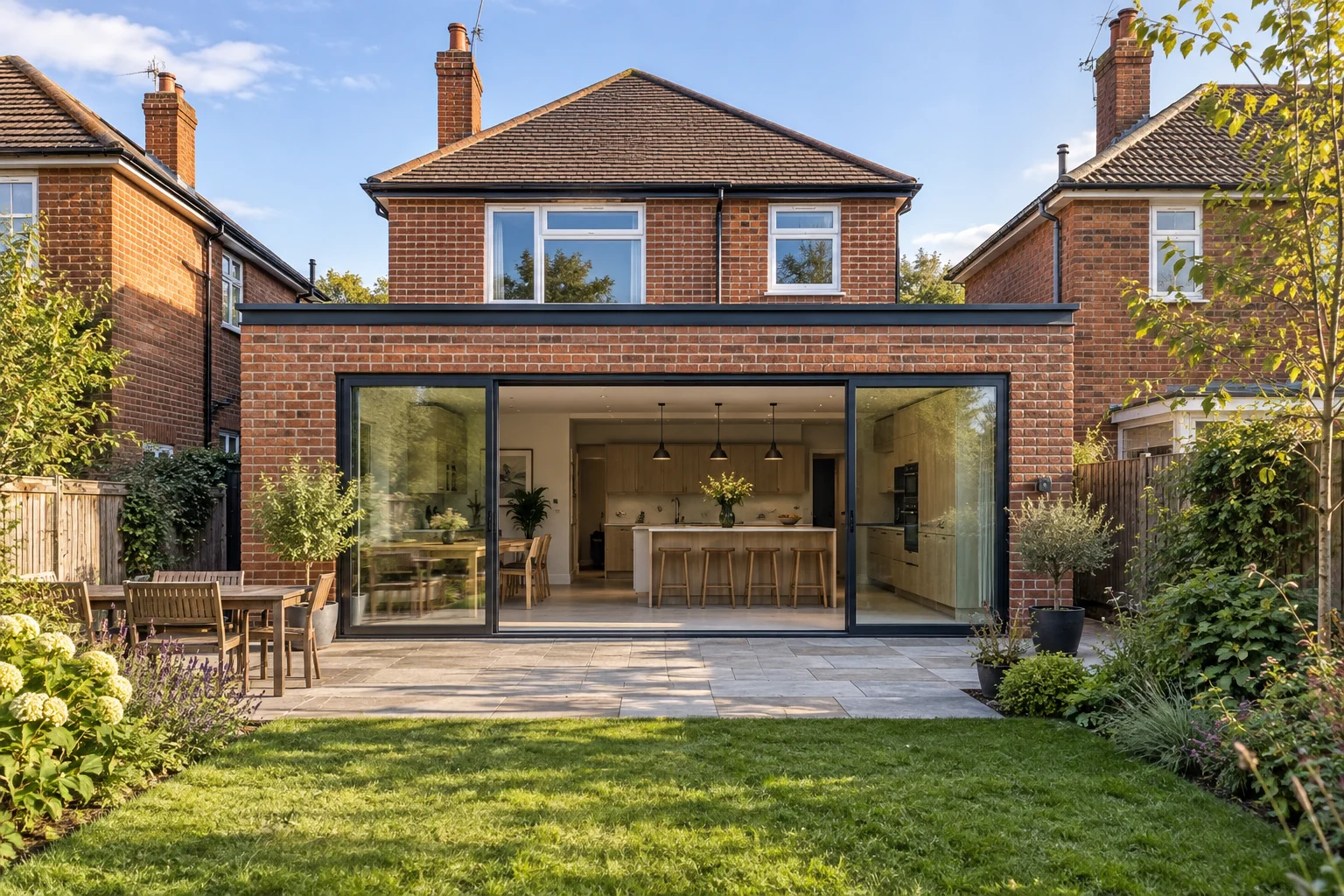
Architectural concept · not a completed company project
TWO-FLOOR HOME EXTENSIONS · NOTTINGHAM
Double-storey extension builders in Nottingham
Create useful rooms on both floors with a two-storey addition planned around your whole house. Speak with Design N Build about your Nottingham home’s upstairs access, room arrangement and construction scope, then request a proposal from coordinated project information.
Prefer to send your project details?OUR PROCESS
Four decisions behind your two-storey building proposal
Start with a conversation. Agree the scope, responsibilities and timing before the next stage begins.
Talk through your project01. Name the rooms
Define the useful accommodation on both floors.
02. Test the route
Show how the upper rooms connect to the landing.
03. Coordinate the scheme
Resolve support, roof and service interfaces.
04. Agree the outcome
Price rooms, retained work and handover boundaries.
YOUR QUESTIONS
Frequently asked questions
From the first conversation to the agreed building work, here are some useful things to know.
Ask us on WhatsAppWhat should I send with a two-storey extension enquiry?
Send the postcode, both existing floor plans and both proposed layouts if they exist. Add the drawing revision, known approval position and a short room schedule describing what the household needs downstairs and upstairs. Identify any room lost or reduced to create access. Mention whether the house will remain occupied and how materials can reach the site. If technical documents are available, provide their register rather than an unexplained set of attachments. This lets the first discussion identify the right stage of appointment instead of assuming an early layout is a complete construction package.
Is a double-storey extension simply twice a single-storey extension?
No. The upstairs circulation, support arrangement, upper roof and two-floor service routes create a different project. Some work relates to the combined structure, while other work depends on the individual room functions and retained-house connections. A headline assumption that the second level doubles either cost or accommodation value is not a reliable scope comparison. Ask for the actual proposal to be assessed and priced, including the rooms changed within the old house, rather than multiplying a ground-floor example taken from a different property.
Can the upstairs addition be reached through an existing bedroom?
That arrangement may reduce the bedroom's privacy and usefulness, so it deserves deliberate design review. Ask the designer to compare the full circulation route with alternatives and show the remaining furniture layout in any affected room. Technical and approval requirements also need assessment. Do not count the new bedroom as an uncomplicated net gain while ignoring the existing room used as its corridor. Explain the household's privacy needs in the brief so the construction proposal follows a layout you have actually accepted.
How do I decide whether a larger landing is worth the space it takes?
Compare the usable room schedule before and after the change. A landing can make new rooms accessible without crossing private accommodation, but the space may be taken from another room. Test that retained room with furniture, door operation and its intended use. Then consider the household benefit of the complete arrangement rather than the landing area alone. Request alternative layouts if the trade-off is unclear. Settle the decision before structural details and service routes are commissioned around a circulation plan you may later want to replace.
Can I add another storey above my existing kitchen extension?
That needs an assessment of the existing addition, its support and the proposed extra loads, alongside the design and approval position. Provide drawings and records of the original construction where available. A structure that currently supports its own roof is not automatically established as suitable for another occupied floor. The assessed solution may retain, strengthen or replace elements. Ask for those findings before requesting a build proposal, and keep this project distinct from a new two-storey extension where the supporting construction is designed as a complete new package.
Should the new upstairs bathroom sit directly above the kitchen?
It is a layout option that needs coordination rather than an automatic rule. The support arrangement, drainage and other service routes, acoustic expectations and desired downstairs ceiling all matter. Ask the responsible designers and installers to show how the proposed combination works. Identify visible boxing or access panels before the fitted kitchen layout is fixed. A bathroom symbol positioned above a kitchen on a general plan does not resolve the construction interfaces or demonstrate that every service can be concealed where you would prefer it.
More project questions 14 answers
When should I choose upstairs sanitary fittings?
Select fittings early enough for their dimensions and installation requirements to inform the coordinated room and service design. The exact milestone should be agreed with the appointed designer, installer and contractor. Late choices can affect connection positions, supports, prepared surfaces and finish dimensions. Provide product information rather than only a catalogue photograph. If you are purchasing the fittings yourself, agree how the selection and delivery dates enter the construction programme so an unconfirmed order does not become an assumed ready-to-install package.
Can the first-floor layout differ from the rooms underneath?
Yes, the functional layouts can differ, but the technical proposal must reconcile their structure and installations. Ask for the two plans to be compared together so upper walls, lower openings and significant service routes are assessed as one arrangement. Do not independently revise a bedroom wall after a structural order without checking the consequences. The aim is a layout that suits both floors and can be built from coordinated information, rather than two separately attractive plans that require unresolved adaptations where they meet.
Will a new upstairs room have a flat ceiling or a sloping ceiling?
That depends on the roof design and the section through the proposed room. Ask to see the usable height above intended furniture positions and the relationship to the existing roof. A plan alone may not explain sloping edges or roof-level constraints. The quotation should refer to the approved and coordinated section and finish specification. If you want to compare ceiling forms, make that an explicit design decision before construction information is completed rather than assuming the external roof appearance determines a particular interior arrangement.
Can I keep the existing roof untouched?
The required work depends on the assessed junction between the new addition and retained building. Some proposals involve alterations to existing coverings, drainage or roof features; others establish a different interface. Ask the designer to define the connection and the contractor to describe the associated retained-roof scope. Separate that necessary work from optional wider renewal. A request to keep the old roof does not establish that every component can remain in place or that no reinstatement is needed when the two-storey addition connects to it.
Are upper-floor windows a decision I can leave until construction?
Their position, operating arrangement and glazing specification can affect room layouts, technical details and the planning assessment. Settle them within the coordinated design rather than treating them as interchangeable finishing items. If a change is proposed later, ask the appointed parties to check every affected document and approval requirement before ordering. Also define measurement and installation responsibility. This keeps the supplied product aligned with the actual opening and the assessed scheme, instead of expecting site adaptations to resolve an unreviewed late substitution.
Does planning permission settle my neighbour and boundary arrangements?
No. Planning, building regulations and applicable party-wall matters are separate processes. An assessed planning position also does not itself give you permission to use someone else's land for access or scaffolding. Ask the appropriate advisers about the actual work and ownership arrangement, and record any necessary permissions before relying on the proposed access plan. Your construction appointment should identify unresolved dependencies. This avoids a start or delivery arrangement being treated as confirmed merely because one approval process has been completed.
Can a two-storey extension use permitted development?
Some proposals may satisfy the relevant England rules, but a project-specific assessment is needed. Extensions of more than one storey have particular conditions, and restrictions or previous additions can affect what is available. Do not rely on a single quoted dimension or a nearby example. Ask the appointed planning adviser to assess your complete scheme, property history and relevant constraints, then retain the evidence and drawing revision on which the conclusion rests. Design N Build's building proposal should state the approval assumptions it is using.
Does a planning-approved drawing set provide everything needed to price the build?
Not necessarily. The set may establish the layout and appearance while leaving support details, construction build-ups, product selections and installations unresolved. Request a drawing and specification review to identify the remaining information needed for a defined quotation. A contractor can describe assumptions or offer a staged approach, but that should not be mistaken for a fully coordinated construction price. Keep the planning decision connected to the actual technical revisions so the building package remains consistent with the assessed proposal as detailing develops.
Can we stay in our upstairs bedrooms during the work?
That depends on which rooms and routes are affected and the assessed construction sequence. Ask for the occupation requirements to be reviewed alongside the new landing connection, roof junction and temporary-stage arrangements. Tell the team which sleeping and washing facilities your household needs. Some stages may require a different arrangement. The fact that part of the original house remains standing does not establish that all existing bedrooms can remain usable throughout. Agree the practical conditions before treating continuous occupation as part of the appointment.
How will materials reach the new upper floor?
The appointed contractor should assess suitable access and handling arrangements for the site and work. Provide accurate information about entrances, external space and known restrictions. Identify any proposed route that depends on another owner's agreement. The quotation should describe its access assumptions and the relevant scope, while responsibility for safe methods stays with competent appointed parties. Ask how retained paths or internal circulation will be protected and reinstated. Do not assume one delivery method is appropriate simply because it was used on a different extension.
What should the price include around the existing staircase and landing?
It should reflect the work actually needed and commissioned to create the agreed upstairs connection. That may include alterations to walls or fittings, floor transitions and specified reinstatement of ceilings and finishes. Ask for the affected rooms and finish boundaries to be named. A local repair differs from replacing flooring or decorating the entire landing. State the outcome you want, then compare quotations on that basis. Otherwise one price may include a complete renewed circulation area while another allows only narrowly defined work beside the new doorway.
Can I have a downstairs shell and a finished bedroom upstairs?
That is a possible scope distinction to discuss, provided the complete design, inspections, safe-use conditions and appointment responsibilities are resolved. Name the exact handover condition for each room and the work left for separate suppliers. Clarify which service routes, surfaces and connections are included downstairs even if its final fit-out comes later. Ask how the stages interact before assuming the upper room can be treated as an isolated finished product while construction interfaces underneath remain undefined. The written proposal should make the differing room outcomes explicit.
What makes two double-storey extension quotations genuinely comparable?
They need to reference equivalent drawings, technical details and finish expectations, with the same affected-room and interface scope. Compare retained-house alterations, access, installed products, service work, reinstatement, exclusions and unresolved items. Separate optional wider roof renewal or garden work from the main addition. Ask how any assumptions will be resolved and how changes will be authorised. A lower total does not show a better purchase when it omits the upper bathroom fit-out or the landing work that another contractor has included in the proposed completed home.
What is the next step if I know the rooms I need but have no drawings?
Call or WhatsApp with your postcode, the accommodation needed on each floor and a description of how the current staircase and landing work. Mention any existing extension you want to build over and whether the household intends to stay during construction. The next discussion can identify design and assessment inputs before a building price is sought. You do not need to invent technical answers to begin the enquiry; the useful starting point is a specific household brief and an honest account of the information still needed.
Commission a two-floor extension around the rooms your household needs
Define the ground-floor and first-floor purchases together
Discuss a double-storey extension in Nottingham with Design N Build when you need additional accommodation both downstairs and upstairs. Your enquiry should identify the useful rooms gained on each floor and the changes needed to reach them from the existing house. A larger kitchen beneath a new bedroom is a different commission from a ground-floor workspace beneath an enlarged family bathroom. The quotation needs to respond to that actual arrangement, including the structural, roof and service connections, rather than assuming that two identical rectangles describe the finished home.
Start with a household accommodation schedule. Name the activities that do not fit comfortably into the current layout and the people who need to use the proposed rooms. Distinguish an additional bedroom from a larger existing bedroom, and a new bathroom from a replacement bathroom relocated within the house. These differences affect circulation, installations and the rooms lost or changed elsewhere. A successful two-floor brief counts the usable accommodation after construction, rather than counting every new square metre as an improvement while ignoring what has been sacrificed to access it.
Design N Build can discuss the building work and the design information needed for a construction proposal. Explain whether you already have measured drawings, an assessed planning position and coordinated technical details, or whether the proposal is still an accommodation idea. Those stages lead to different conversations. Agree the scope of any design, survey or construction appointment directly. An initial discussion can identify the next useful input without presenting an undeveloped sketch as a sufficiently specified fixed-price building package.
Choose this service for a genuinely two-level project
This page focuses on an addition that creates accommodation on two levels, with particular attention to the landing connection, room stacking and disruption across existing floors. For a ground-floor-only addition, review the [single-storey extension service](/single-storey-extensions/). If you are primarily comparing extension forms, the [house extensions page](/house-extensions/) gives the broader starting point. Tell us if you intend to build upwards over an existing addition: that requires a separate assessment of the retained construction and should not be treated as equivalent to a new two-storey extension built from the ground.
Make the landing connection work before fixing the new bedroom shape
Trace the route from the existing staircase
Draw the route a person will take from the stair head to each new upper-floor room. Identify door positions, turning spaces and the existing rooms crossed or altered along that route. Access through another bedroom may undermine privacy even when the new room looks generous on a plan. A landing enlargement can improve the arrangement, but it takes space and may affect walls or services. Ask the designer to show the complete circulation outcome so the construction scope reflects the access you actually need.
Compare the existing and proposed room schedule side by side. If part of a bedroom becomes a corridor, record its remaining shape and whether it still accommodates the intended furniture. If a bathroom moves, show what happens to its previous location. A drawing that labels an additional bedroom without explaining the displaced functions can overstate the benefit. This is a useful point to reconsider the layout before technical detailing and procurement make the arrangement expensive to change.
Test the upper plan against ordinary household movement. Think about carrying bedding, reaching storage and using the bathroom during the night. Consider which doors are likely to be open together and whether they obstruct each other. These are design questions to settle before the doorway construction is priced. Avoid judging circulation solely from a visualisation with doors and furniture removed; the room connection has to work with the actual fittings and the way the house will be occupied.
Include landing alterations in the building proposal
An upper-floor doorway can involve more than forming an opening. The package may need to address supporting construction, displaced fittings, altered skirting, ceiling repairs and the transition between floor finishes. Name the affected existing spaces and their required completion condition. If the old carpet will be replaced across the whole landing, say so. If the scope is limited to local reinstatement, recognise the possible visual difference. Agree that boundary explicitly instead of expecting an unspecified making-good allowance to deliver a completely renewed upstairs circulation area.
Stack room functions so the two plans can be built as one proposal
Compare what sits above the important space below
Place the ground-floor and upper-floor drawings on the same grid and compare walls, openings and fixed equipment. A bathroom above a large open kitchen has different coordination needs from a bedroom above a cellular utility room. The designer and engineer need to resolve the support arrangement for the chosen layout; an attractive upper plan should not be developed in isolation from the space beneath it. Share both levels when asking Design N Build to discuss construction, including existing rooms where loads or installations may connect.
Do not assume upper partitions, bathroom fixtures and lower openings can be repositioned independently after the building structure is ordered. Ask which dimensions are still design choices and which depend on the coordinated support proposal. A revision to one wall can affect several drawings and supplier orders. Keep a decision record identifying the current layout revision so a kitchen supplier, bathroom installer and structural designer are not working from incompatible versions of the same house.
Where new accommodation serves several purposes, identify the dominant requirement on each floor. For example, a quiet upstairs workspace may need a different relationship to the family area below from a room used only for storage. Explain these expectations before finishes are specified. The construction enquiry can then address the relevant interfaces and the appointed designer can assess the appropriate arrangement, instead of the household discovering that a preferred layout conflicts with the way it intends to use the rooms.
Treat services and structure as coordinated routes
Ask for drawings to show important service routes alongside the agreed structural arrangement. A pipe, duct or cable cannot simply pass through any convenient beam position. The relevant designers and installers should identify compatible routes and any necessary access. Record where boxing or a service zone will remain visible. That information changes the practical room dimensions and may affect cupboards, sanitary fittings or ceiling appearance. Knowing the trade-off early is more useful than assuming every installation will disappear within a floor of unspecified construction.

Establish the retained-building assessment behind the support design
Confirm which existing elements will carry or connect to new work
The technical assessment should identify whether new construction is independently supported or relies on parts of the retained house. Supply available records of previous alterations and describe anything already known about the affected walls or foundations. A photograph of a similar extension does not establish the load capacity of your property. Where the proposed arrangement depends on hidden conditions, ask what inspection or investigation is required before the design and the quotation can be sufficiently defined.
For an addition over an existing single-storey structure, provide any original drawings, calculations and inspection records you hold. Missing documents do not prove that the structure is unsuitable, but they also do not establish that it can support another level. A competent assessment may require further investigation or a redesigned support arrangement. Keep the assessment appointment and the resulting construction decision separate. The building price should follow the assessed scheme, including any strengthening or replacement that has actually been specified.
Discuss the opening between old and new on each floor. A large ground-floor opening and a smaller doorway above may interact through the retained wall or proposed support system. Describe both together, along with the desired finish around each opening. The contractor's proposal should identify the technical information being priced. An allowance labelled structural work is too vague to compare if one quotation assumes a fully designed system and another assumes that substantial design decisions will be resolved after appointment.
Identify the temporary-stage responsibilities
Construction is not only the final arrangement shown on the architectural plan. Ask which appointment covers the design and execution of temporary support, the sequence for forming openings and the checks needed before loads are transferred. Do not infer a safe method from this page or undertake preparatory removal yourself. The appropriate approach depends on the assessed building and the appointed competent parties. Clarifying the responsibility before work starts is part of buying a coordinated construction package, particularly when both inhabited floors are affected.
Official reference: GOV.UK: building regulations approval
Coordinate the new roof with the first-floor room and existing roof edge
Review a section through the upper accommodation
An upper room's usable shape depends on the roof arrangement, ceiling heights and any sloping edges. Ask for a section that shows the new roof and its relationship to the existing house, not only a floor plan and external perspective. Identify where a wardrobe, bed or desk will stand under the proposed ceiling. The designer should demonstrate whether those uses fit the actual space. A room labelled with a generous floor area can still have constrained furniture positions if important sections have not been considered.
The junction with the old roof needs an explicit detail and a clear scope for retained work. Tell us whether existing coverings, gutters or roof features are to be altered and what appearance you expect after reinstatement. If the proposal affects an existing roof window, aerial or service penetration, identify it in the drawing set. The building package should account for removal, replacement or relocation rather than assuming that everything at roof level can remain in place while the new structure is connected.
Ask how rainwater from the combined roof arrangement will be managed and maintained. The designer's proposal needs to consider the roof geometry and discharge routes relevant to your property. Confirm which gutters, downpipes and connections belong in the quotation, and which existing components remain. An apparently minor change in roof form can alter the work around a boundary or a garden route. Include those interfaces before judging alternatives solely by their appearance from the street.
Decide what roof-level work is included elsewhere
Some homeowners want the adjoining old roof refurbished while access is available. That can be considered as a separate option, with its own assessed scope and condition assumptions. It is not automatically included in a double-storey extension price. Distinguish works required to form the designed junction from elective renewal of unrelated roof areas. This helps you compare the main addition accurately and decide whether accompanying maintenance is sensible within your budget, rather than leaving the contractor to guess the extent of the desired renewal.
Select upper-floor windows for room use, privacy and the assessed planning position
Test the outlook from the furnished room
Review upper windows from the positions where the room will be used. A desk may need a different outlook and glare arrangement from a bed or dressing area. Check where wardrobes and radiators will sit, how opening parts operate and which fittings are close to the window. Those decisions influence the product specification and surrounding construction. Supply the current window schedule when requesting a quotation so the price relates to actual selections rather than a presumed standard unit for every opening.
The effect on neighbouring properties belongs in the design and planning assessment. Do not assume that a view is acceptable simply because an existing window faces a similar direction. The proposed height, position and relationship to surrounding buildings may differ. Tell the appointed adviser about known constraints and supply any relevant planning correspondence. If a particular glazing or opening arrangement forms part of the assessed proposal, preserve that information in the specification instead of substituting a preferred product without checking the implications.
Discuss how the selected windows will be cleaned, opened and maintained. The appropriate solution needs to meet the assessed technical requirements as well as the household's preferences. Do not choose a product solely from an exterior photograph if the operating arrangement is unclear. Identify who checks the specification, confirms dimensions, orders the units and coordinates installation. If the homeowner is purchasing the windows separately, agree how delivery dates and product information will be connected to the construction programme.
Keep the elevation and room schedules consistent
The visible composition of a two-storey addition can involve windows on both floors, external finishes and the roof above. Ask for the final elevation and product schedules to agree before orders are placed. A revised bedroom layout may change a window position; that change should appear in every affected drawing and approval assessment. Design N Build's construction proposal can then refer to a coordinated revision, reducing ambiguity about which appearance and internal arrangement the appointed building work is meant to deliver.
Design the upstairs bathroom without creating unresolved work below
Follow each installation back to its connection
If the extension includes an upstairs bathroom or en-suite, show the route from each fixture to the proposed service connection. The room may look straightforward on the upper plan while drainage, ventilation or supply work affects a retained room below. Ask the responsible designers and installers to resolve those routes before the lower ceiling and kitchen details are finalised. Record where access panels, boxing or external pipes will be visible so the finish expectation reflects the design actually being built.
Consider the sanitary layout with door movement and day-to-day use. A basin placed to suit a decorative elevation may obstruct access to a shower or storage. Fixtures should be selected with their dimensions and installation requirements, rather than represented by interchangeable symbols until the first-fix stage. Supply product information to the relevant appointed parties. The construction proposal should distinguish fitting supply, installation, substrates, finishes and testing responsibilities so the bathroom is not treated as a loose collection of separately purchased objects.
Decide whether the existing bathroom will remain operational during the work. If it is being moved or connected to the same installation work, the programme may need a specific changeover arrangement. Tell us how many people will be living in the house and which facilities are essential. An occupied-household requirement can affect the proposed sequence and temporary provision. Do not rely on a general assurance that the extension is outside the house when its services connect to a room that the household needs every day.
Coordinate fit-out and completion evidence
Where a separate bathroom supplier or installer is involved, agree the construction condition handed over to that appointment. Specify the relevant dimensions, prepared surfaces, connection locations and any unfinished interfaces. Ask which records each installer will provide and what applicable inspection or certification remains with another appointment. For a more detailed fitted-room enquiry, see [bathroom renovation](/bathroom-renovation/). The two-floor extension scope still needs to include the routes and building interfaces outside the bathroom itself, even when the final fit-out is purchased separately.
Ask for a complete approval assessment for the particular Nottingham property
Establish the correct planning route before pricing assumptions harden
A two-storey extension needs a property-specific planning assessment. England's permitted-development rules contain conditions for extensions of more than one storey, and some situations require a planning application. Previous additions and restrictions affecting the house can change the position. Ask the appointed adviser to assess the complete proposal and explain the evidence supporting the route. Do not use this page, a neighbour's extension or an isolated dimension as confirmation that your preferred addition can proceed without an application.
Your Nottingham-area postcode should identify the actual planning authority for the property; a marketing description of the area is not sufficient. Supply relevant previous decisions, conditions and drawings where you hold them. Ask which drawing revision has been assessed and how later changes will be checked. A window relocation, revised roof or additional ground-floor work may need reconsideration. The construction quotation should describe its approval assumptions and the consequences if the scheme changes, rather than silently assuming that an early visual concept is the authorised construction package.
Building regulations approval is a separate matter from planning permission. Agree the appropriate building-control route and the technical information required for the proposed extension. Record who submits the information, who coordinates inspections and which completion records will be sought. A planning decision does not confirm the construction details or replace building-control obligations. Link the quotation to the coordinated drawings and assessed requirements, including the alterations to the original house, so the work is priced on the same basis as the proposal being reviewed.
Resolve boundary-related duties in parallel
Work affecting a shared structure or involving certain nearby excavation may require consideration under the Party Wall etc. Act. Planning permission and building regulations approval do not replace that separate process. Seek appropriate advice about your actual proposal and identify responsibilities before relying on a start date. Also agree any access that would require permission from someone else. A scaffold position shown outside your own land is not an established right to use it. These matters belong in the readiness discussion before construction arrangements are committed.
Official reference: Planning Portal: England extension planning conditions
Plan occupation around work on both existing floors
Identify rooms that must remain usable at each stage
Map the affected household functions across the programme. The ground floor may lose part of its kitchen or circulation route while the first floor is opened to form a new doorway. List sleeping, washing, cooking and access requirements separately, including the rooms expected to remain available. Ask for a proposed sequence that recognises those needs and explains any stage when they cannot be met. Occupation is a project condition to assess, rather than an assumption that follows from retaining a front door and some untouched rooms.
Upper-floor work can affect privacy, security and weather protection while the addition connects to the original building. Discuss how boundaries between work areas and household areas will be established, who controls access and what temporary arrangements are proposed. The particular method must follow the assessed project and competent site arrangements. Tell the team about children, pets, working patterns or other circumstances that influence access requirements, without assuming a website can decide whether the house is suitable for occupation during every stage.
Ask when significant interruptions to utilities or room access are likely within the proposed sequence. A useful programme identifies dependencies and decision points, not only an optimistic completion date. Delivery changes, inspections and discovered conditions can affect the plan. Agree how updates will be communicated so the household can make practical arrangements. If temporary accommodation becomes necessary, that decision should be considered against the assessed work stages and your needs, rather than discovered after the existing upstairs connection has already been opened.
Keep finished rooms out of the construction route where possible
Describe how materials and waste will move to and from upper work areas. If the existing staircase or landing becomes a transport route, the package needs an agreed approach to protection and eventual reinstatement. Record which surfaces are retained and which will be replaced as part of the project. Photographs of the pre-work condition help establish the baseline. Ask how the route will be managed in the proposed site arrangements; do not presume that access to an external scaffold eliminates all movement through the occupied house.
Price height-related access, deliveries and external reinstatement explicitly
Agree what the access package actually includes
A double-storey addition involves work above ground level that needs suitable access arrangements. The construction proposal should identify the relevant access scope and the assumptions on which it is based. Discuss the available space for equipment, deliveries and storage, and explain any restriction imposed by the property or adjoining ownership. Responsibility for selecting safe methods belongs with the appointed competent parties. The homeowner's useful contribution is accurate access information, not a suggested shortcut to reduce the quote by omitting necessary arrangements.
Consider the whole delivery route from the road to the point where materials are used. A narrow entrance, overhead obstruction or limited unloading space can influence the assessed construction logistics. Provide photographs and measurements only where they can be obtained safely, and distinguish estimates from surveyed information. If access depends on a neighbour's agreement, record that dependency clearly. The quotation should not assume permission, a parking arrangement or a delivery method that has not been established for the actual site.
External surfaces can be affected by both the new footprint and the construction access. Name paths, garden structures, planting and hardstanding you intend to retain, remove or reinstate. A larger addition changes how some of those areas are used afterwards. Set the required completion condition instead of leaving every outside item within an unspecified tidy-up. If separate landscaping follows later, define an appropriate interim condition and clarify the boundary of that later appointment so the building contractor's finish obligations remain intelligible.
Review the programme implications of separately purchased items
Client-supplied windows, roof products or fitted furniture should have identified information and delivery milestones. Agree where items can be stored and how damage or discrepancies will be reported before installation. Upper-level access arrangements may depend on the sequence, so a delayed specialist item can affect more than its own fitting date. The quotation and appointment should explain the treatment of changed requirements without promising that every supplier delay can be absorbed at no cost or with no effect on the programme.
Compare quotations by the complete two-floor outcome
Use a room-and-interface scope rather than a footprint price
Request a proposal that references the current architectural and technical information, then identify the completed condition of every affected room. Ground-floor and upstairs work should be described together, with interfaces to the existing house visible. A shell package, a decorated addition and a fully fitted kitchen-and-bathroom project are different purchases. Distinguish each before comparing totals. A price expressed only as a cost per square metre can conceal substantial differences in retained-room alterations, fitted products and service connections.
Ask how the quotation treats identified uncertainty. An investigation yet to be completed, an unresolved finish choice and a client-requested option are different categories. They should not all sit under one contingency label. The appointment should explain what is included, what is excluded and how later instructions will be priced and authorised. If a provisional item affects both floors, record the consequences for each instead of assuming its eventual resolution will leave the rest of the scheme unchanged.
Discuss payment stages against understandable outputs or the agreed contractual arrangement. Ask how progress will be recorded and how separately purchased products are treated. The website does not establish payment terms or a fixed project price. Those belong in the actual proposal and appointment. You can use [construction cost-estimation support](/services/cost-estimation-boq/) if you need a defined cost-information package at an earlier stage, while recognising that an estimate based on evolving drawings is different from a construction quotation for an agreed scope.
Choose the next enquiry according to the information you have
If only the accommodation brief is ready, request a discussion of the design and assessment inputs needed next. If an approved layout lacks coordinated technical details, identify those gaps before inviting an apparently complete build price. If the full package is ready, send the drawing register, specification and known access conditions. [Architectural design support](/services/architectural-design/) can be discussed where appropriate. Selecting the right next appointment makes the enquiry more useful than sending different contractors unrelated sets of information and expecting directly comparable prices.
Agree the two-level handover and retained-house finish
Walk through the complete route and room schedule
The completion review should follow the household journey through the changed house, including retained areas affected by construction. Check the new upstairs access, room doors, installed fittings and the downstairs connection against the agreed scope. An attractive external addition is not the only outcome being purchased. Record outstanding work by location and responsibility so items within the building appointment can be distinguished from products or tasks belonging to separate suppliers. Agree how those items will be addressed through the contractual process.
Ask for the applicable inspection, installation and product records to be identified in the appointment before work begins. Different appointed parties may produce different documents, and some approvals follow their own process. Keep the records connected to the drawing revisions and relevant installed components. A bundle of unlabelled documents is less useful when maintaining the extended house later. Product instructions, accessible service points and the location of concealed routes can help the homeowner understand what has been delivered without treating a contractor's informal explanation as regulatory certification.
Where making-good work meets retained finishes, compare the result with the agreed boundary. A local patch and complete redecoration of a landing are different expectations. If a client-selected change alters that boundary during construction, update the written scope and price treatment. This makes the final review fairer and reduces disagreement about work neither party clearly described at appointment. It also lets you plan any intentionally deferred renewal separately instead of finding that an important retained room has no defined completion condition.
Begin with both floor plans and your postcode
Call or WhatsApp Design N Build to discuss a double-storey extension for your Nottingham-area home. Share the existing and proposed arrangements on both floors, the design or approval stage, and any known access or occupation restrictions. If you have no plans yet, describe the additional room functions and how you expect them to connect to the house. Use the [contact page](/contact/) to outline the enquiry. We can then discuss the information and appointment appropriate to your actual stage, without pretending that every two-floor addition has the same scope.
DOWNSTAIRS SPACE · UPSTAIRS ACCOMMODATION
Make both floors work together.
Call or WhatsApp the Nottingham team with your postcode, both layouts and the information you have about the proposed addition.