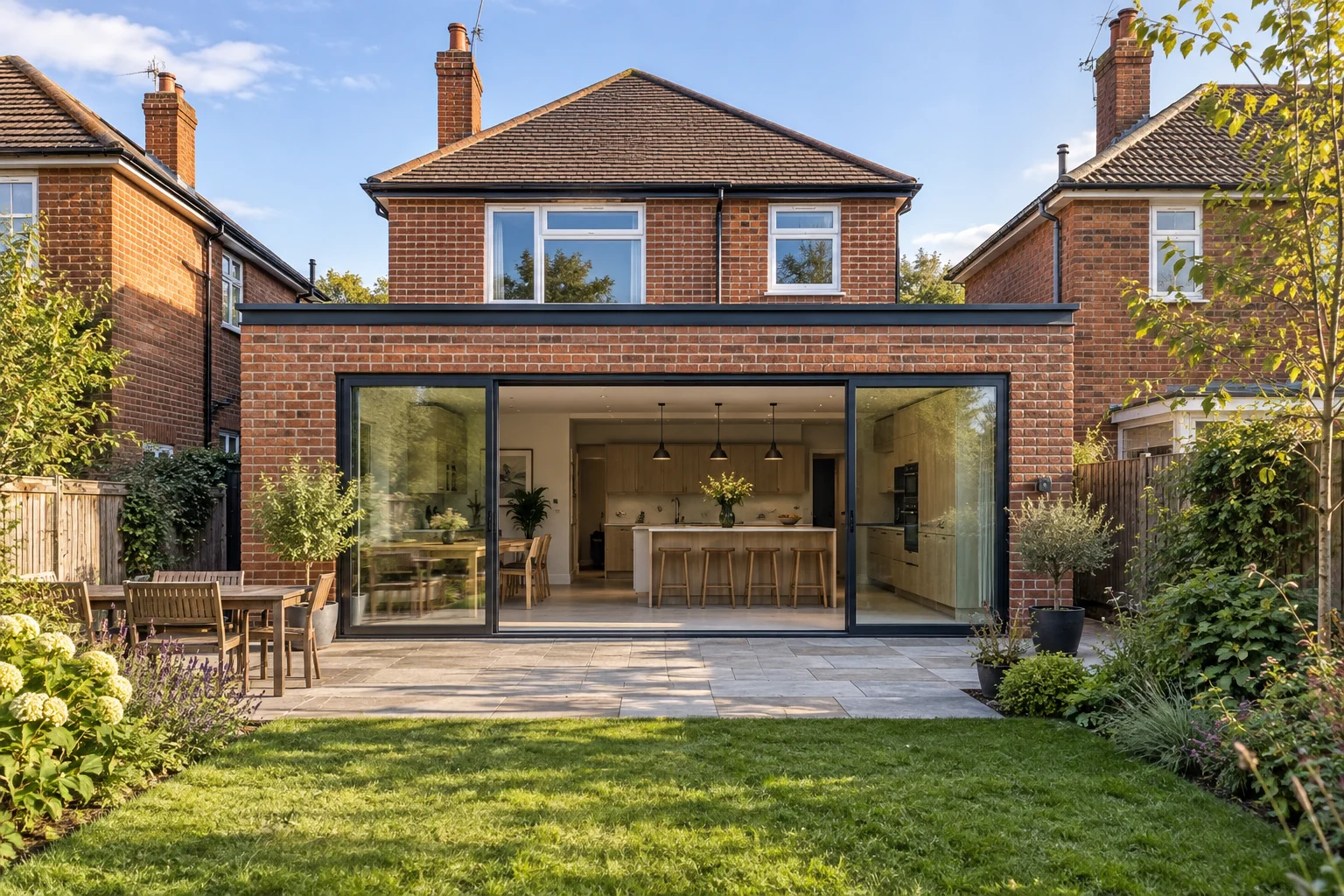
Architectural concept · not a completed company project
NOTTINGHAM · GARAGE CONVERSIONS
Garage conversion builders in Nottingham.
Give your garage a useful new purpose. Discuss a home office, family room, utility space or a better ground-floor layout with our Nottingham building team.
DESIGN & BUILDConnect your plans and building work
CLEAR PROJECT SCOPEDiscuss the detail before you appoint
TALK TO OUR TEAMCall, WhatsApp or send an enquiry
YOUR PROJECT, CLEARLY DEFINED
Turn garage space into a room with a defined purpose
Enquire about a garage conversion for a home office, playroom, utility or family room. A conversion needs more than a new window and decoration: the existing condition, floor construction, comfort, services and connection to the house all affect the work required.
Decide what the conversion should deliver
Proposed use
Include in the brief
Resolve before pricing
Home office
Desk position, storage, lighting and separation from household activity.
Daylight, sockets, heating and the route back to the house.
Playroom or family room
Furniture, toy storage and access from the main living space.
The finished floor relationship, doors and practical storage elsewhere.
Utility room
Appliance sizes, worktop, cupboards and water requirements.
Service routes, ventilation, fitting responsibilities and adjacent making good.
Partial conversion
The new room and the garage or store you want to retain.
The dividing construction and separate access for stored items.
Assess the existing garage before selecting finishes
Tell us whether the garage is integral, attached or detached. Send photographs of the frontage, inside walls and the threshold to the house, where accessible. Mention visible damp, a leaking roof, previous alterations or a floor lower than the adjoining room. Photographs help explain the enquiry; they cannot establish the cause of a defect or confirm that a construction detail is suitable.
The new use should inform the investigation and design. A utility room needs different service connections from a desk-based office, while a detached building may have a different access and supply arrangement from an integral garage. Do not assume every garage can be converted on the same specification. Ask which checks are included in the appointment and what happens if opening-up reveals additional work.
Keep storage and permissions in the decision
List the bikes, tools and household items currently stored in the garage. If they need to remain, compare a partial conversion with a full conversion and a separate storage solution. Sketch the movement of the largest items through the proposed doors. A leftover strip of floor is not useful storage if equipment cannot reach it. Include the condition of the retained area in the scope.
Planning Portal explains that many internal garage conversions without enlargement may not need planning permission, but property-specific restrictions can change that position. Previous conditions concerning parking or use need checking. A separate residential unit is a different proposal from an extra room within the existing home. Building regulations and any other relevant consents should be addressed before work begins.
Make your first enquiry useful
Postcode, garage type and the room or combination of uses you want.
Frontage, internal and threshold photographs taken without disturbing the building.
Storage to retain and any known damp, roof or previous-construction issues.
Available drawings, required appliances and how you want the room to connect to the house.
Is an integral garage different from a detached garage conversion?
Yes. An integral garage forms part of the house’s overall arrangement, while a detached garage has a separate relationship to the home. Access, services and the intended use may therefore need different consideration. Describe the garage type and show the route to the house. A detached office and an extra room within the household are not interchangeable specifications. Suitability and cost depend on the existing condition and assessed proposal.
Can I convert only part of the garage and keep some storage?
A partial conversion is worth discussing if you need another room but still require storage. List the items to retain and check their access route on the proposed layout. The dividing construction, doors, services and finishes need to suit the different uses. Include the retained area in the quotation so its final condition is clear. A narrow leftover space is not a satisfactory store if bikes or equipment cannot get in and out.
Will replacing the garage door improve the front of my house?
A replacement frontage can be designed to relate to the house, but the appearance should be considered alongside daylight, internal layout and construction requirements. Show the proposed window or door arrangement with the rooms behind it. Matching existing brickwork or detailing may need particular consideration and should not be promised without assessment. Ask what the frontage package includes and confirm any applicable planning restrictions before ordering windows or other made-to-measure components.
Does a garage conversion always need planning permission?
Not always. Planning Portal states that many internal garage conversions without enlargement may not need planning permission, although restrictions and particular circumstances can change the position. Check previous planning conditions and the intended use, especially if separate accommodation is proposed. Building regulations are a different matter. Use the full address and project description with the relevant adviser or authority before treating a conversion as permission-free.
Can the garage become a bedroom or guest room?
A bedroom or guest room can be included in the proposal, but it must be assessed for that intended use. Explain whether it remains part of the existing household or is intended as separate accommodation. Access, room layout, services, comfort and relevant safety requirements need proper design. Do not commission a cosmetic storage-room refurbishment while assuming it will automatically be suitable for sleeping accommodation. Ask the assessment and quotation to describe the actual outcome you want.
How much does a garage conversion cost in Nottingham?
The price depends on the garage’s condition and the room being created. Floor construction, damp or roof repairs, the replacement frontage, insulation, services and the connection to the house can change the scope. A fitted utility also differs from a simple office. Send photographs, dimensions where known and available plans for a quotation discussion. Ask for allowances, exclusions and VAT treatment to be stated so the proposed price is understandable.
More project questions 18 answers
Can you visit before I decide whether to convert the space?
Ask about the appropriate assessment stage when you make contact. Provide enough information to establish the location, intended room and questions you need answered. An enquiry can lead to a discussion about a visit or further professional input, but it is not itself a confirmed appointment or a promise of a free survey. Clarify what any proposed visit covers, whether a written report or drawings are included and what fees or terms apply. If you are comparing a conversion with an extension, explain that beforehand so the assessment addresses the real decision. The value of an early visit lies in reducing uncertainty about the brief, not producing an instant construction commitment from incomplete information.
What if the garage floor is below the house floor?
That relationship needs to be assessed within the proposed floor construction and layout. Do not assume the difference can be resolved simply by adding a particular floor covering. The design must consider the available height, thresholds, door openings and the connection to the existing home. Explain any practical access needs and show the designer which rooms the new space will connect to. Ask for the finished level relationship to be made clear in the drawings and specification. The final construction detail should come from the appropriate project design, not an online rule of thumb. Resolve it before ordering flooring or booking fitted furniture that depends on the completed dimensions.
Will you check for damp before the room is finished?
Identify known damp, leaks or recurring marks as part of the initial brief and provide any survey findings. The appointment should explain what investigation is included, who carries it out and how unresolved conditions affect the proposal. A visual conversation is not the same as a specialist diagnosis, and concealed problems cannot be responsibly ruled out from photographs. Ask how findings will be addressed before surfaces are covered and how additional work will be approved if required. You should understand the distinction between treating a known defect, changing the construction for the new use and applying decorative finishes. The scope should not rely on simply hiding symptoms behind new linings.
Can the conversion include a utility room with appliances?
Yes, a utility room is a useful brief to discuss, but the appliances and fittings need specifying early. Provide dimensions, product information and the arrangement you want for laundry, storage and worktops. Explain which items you will supply and which you expect the quotation to include. Service routes, ventilation, installation requirements and maintenance access need coordinating with the construction. Ask whether cabinetry, appliance connection, lighting and final decoration are within the scope or separate appointments. Do not order the full fit-out from approximate measurements before the finished layout is established. A clear division between building work, product supply and installation helps avoid gaps where each supplier assumes another party is responsible.
Is it possible to open the garage into the kitchen?
That is a broader remodelling proposal than creating an independently accessed room, so describe it clearly from the outset. The new opening, existing structure, floor relationship and kitchen arrangement need coordinated design. Share drawings of the whole affected ground floor rather than only the garage outline. Include the kitchen supplier's requirements when available and clarify who is responsible for structural advice and the relevant approvals. The quotation should identify making good and finishes in the existing kitchen as well as the garage. An appealing open-plan sketch is not evidence that an existing wall can be removed without assessment. Establish the design and responsibilities before treating the combined area as a ready-to-build project.
Will the finished space be comfortable throughout the year?
Comfort should be part of the specified design, not an assumption attached to the word conversion. Discuss the proposed treatment of the floor, walls, roof, openings, heating and ventilation with the responsible team. Explain how often the room will be used and what equipment or furniture it will contain. The existing building and services may require assessment before appropriate details can be established. Ask what is included in the construction scope and whether any work elsewhere in the house is necessary. A website cannot guarantee a particular room's performance without that information. Your appointment should define the intended construction and services so the completed space is designed for its actual use rather than merely decorated like a domestic room.
Can I keep the existing garage roof?
Retention may be possible, but it depends on its condition and the proposed conversion design. Share any history of leaks, repairs or survey advice and identify areas that concern you. Ask which inspection or professional assessment is needed before a decision is made. The construction scope should distinguish retaining the roof, repairing identified defects and replacing particular elements. Do not interpret a garage conversion quotation as a whole-roof renewal unless it expressly includes that work. Equally, avoid finalising the interior while a known roof issue remains unresolved. The appropriate decision is the one supported by the building assessment and the requirements of the new room, with any associated cost clearly recorded.
Can the new room be used as a home office?
A home office can be a strong use for the space when the practical brief is clear. Describe desk dimensions, screens, storage, equipment and whether calls require separation from household activity. Consider window positions and privacy from the driveway, not just the number of sockets. Decide whether data cabling, fitted furniture and decorative lighting are part of the contractor's scope or supplied separately. Any change to the building still needs the appropriate assessment and approvals for the actual proposal. The room should be designed around daily use, with sensible access to controls and maintenance points. Sending those requirements at enquiry stage supports a more useful quotation than asking only for an office finish.
Do I need to empty the garage before the project begins?
Agree the clearance requirements and timing before the construction start. List large or awkward items and confirm whether moving or disposal is your responsibility or a separately priced service. Do not assume stored contents are included in general building-waste handling. Where materials may need specialist assessment, avoid disturbing them without appropriate advice. Discuss access to cupboards, meters or other equipment that must remain available during the work. Clearing the space can also reveal conditions that need attention, so allow that information to be communicated before the scope is treated as fully resolved. A practical clearance plan protects your belongings and helps the team begin with a usable work area rather than an unplanned storage problem.
How disruptive is a garage conversion while I live at home?
The impact depends on how the garage connects to the house and which services or existing rooms are affected. Work within a separate space may have different arrangements from a scheme opening directly into the kitchen, but neither should be assumed disturbance-free. Discuss access routes, separation, noise, dust and any planned service interruptions before appointment. Explain working-from-home needs, pets or other practical household constraints that influence site arrangements. Ask how you will be informed when a stage changes the normal route through the home. A sensible pre-start plan is more useful than a generic promise of minimal disruption because it addresses your actual layout and the construction work being commissioned.
How long does the building work normally take?
Request an indicative programme for your defined scheme rather than relying on a general duration that ignores its condition and fit-out. Assessment, design, approvals and product selection happen before or alongside the preparation for construction. During the build, access, procurement, inspections and discoveries can affect sequencing. A simple room with agreed products is not directly comparable with a garage linked to substantial kitchen remodelling. Ask which decisions must be made before the start and how changes to the programme will be communicated. Do not schedule a fixed first use, tenant arrival or installation by another supplier from an informal enquiry alone. Confirm readiness against the actual agreed scope and progress.
Can I buy the flooring or cabinetry independently?
Yes, discuss the arrangement before placing orders or promising an installation date to a supplier. The construction team needs product dimensions, preparation requirements and delivery information. Agree who checks suitability, receives the goods, stores them safely and resolves damaged or missing items. Clarify whether the quotation includes installation, connection and making good or leaves those to the product supplier. Independent purchase does not automatically reduce the building scope by the product's retail value, because preparation and coordination still need to be defined. Keep responsibilities explicit and ensure the finished measurements are confirmed before bespoke items are made. This reduces the risk of a late delivery or incompatible product delaying completion of the room.
Will decoration and flooring be included in the quote?
Only the accepted scope can establish that. Ask the quotation to distinguish plastering, surface preparation, painting and final floor covering, including the areas of the existing house affected by the connection. A room ready for decoration is not the same as a room handed over with a specified painted finish and installed flooring. Where products are unselected, ask for the allowance and installation basis to be clear. Identify skirtings, thresholds and internal door finishes as well as the main wall surfaces. This detail makes proposals easier to compare and prevents a lower total from appearing equivalent when it actually stops at an earlier stage of completion than you expect.
How will unexpected defects affect the price?
The quotation and project terms should explain how work beyond the known scope is handled. If an unexpected condition is discovered, ask for it to be documented and for the proposed response, cost and programme effect to be presented before additional work is authorised, subject to any immediate safety needs. Some issues require professional advice before options can be assessed. Keep that process separate from discretionary changes you request during the build. A well-defined variation route does not remove every uncertainty from an existing building, but it gives you a clear way to make decisions. Avoid relying on a vague promise that a price includes everything when the underlying construction has not been fully established.
Could I turn the garage into a separate rental unit?
That is a materially different brief from adding a room to the existing home. State the intended use openly and obtain the appropriate planning, building and other professional advice before commissioning construction. Do not assume a conversion designed as a household office or guest space can later be used independently without further consideration. Access, services, layout and the relevant approvals need to be assessed for the actual proposal. The website's ordinary garage-conversion descriptions are not confirmation that separate accommodation is lawful or suitable at a particular address. Any construction appointment should follow a properly developed scheme with responsibilities and approval requirements identified, rather than using a simple room-conversion package for an unassessed purpose.
What documents should I keep after completion?
Retain the accepted quotation, drawings, specification and authorised variations, together with the completion information relevant to the work. Discuss in advance which certificates, approval documents and product instructions are expected and who provides them. A clear handover record should also identify outstanding tasks and the contact route for snagging or aftercare under the agreed terms. Keep supplier information for any products you bought yourself, because the responsibilities may be separate from the building appointment. This documentation helps explain what was changed and how installed items should be maintained. It should reflect the actual project rather than a generic promise that every possible certificate is included regardless of the scope.
Can you combine the conversion with other renovation work?
Describe the related work at the beginning and ask for the interfaces to be planned together. A garage conversion linked to kitchen remodelling, utility installation or ground-floor refurbishment can involve shared access, services and finishes. Separate your priorities so the team can explain which elements are essential to the conversion and which are optional additions. Request a quotation that identifies the combined scope and any phasing, rather than assuming a broad renovation heading covers every room. Coordination can make the overall project more coherent, but it does not remove the need for defined responsibilities and decisions. Keep the accepted specification consistent across all areas so work in one room does not contradict the planned finish in another.
How do I start a garage conversion enquiry?
Contact Design N Build with your postcode, the garage type, approximate dimensions and a short description of the room you want. Add safe photographs of the inside, frontage and connection to the house, plus any existing drawings or survey information. Mention known damp or roof issues and the timing you are considering. Use the enquiry form for a structured brief, call for an initial conversation or WhatsApp the relevant images. The first step is to establish suitability and the information required for an assessment or quotation. It is not a booking to begin construction. Any paid visit, design work or building appointment should be agreed separately with clear scope, responsibilities and terms.
Make your garage work harder for your household
Tell us what the new room must do
A garage conversion should solve a specific space problem. You may need a ground-floor office, a playroom that can be closed off, a utility area, a larger kitchen or an additional sitting room. Each brief changes the layout, the connection to the house and the work that needs pricing. Tell Design N Build how the garage is used now, what you want to replace that use with and which existing rooms should remain untouched. Include photographs and your Nottingham-area postcode with the first enquiry.
Start with the everyday detail. A workspace may need a desk wall free of glare and reliable separation from family activity. A playroom needs storage and a practical route back to the main living space. A utility room needs appliance dimensions and service requirements considered early. These details help develop a conversion that functions properly rather than simply replacing a garage door with a window and calling the resulting space complete.
Account for what the garage currently stores
Before committing the whole space, decide where bikes, tools, garden equipment and seasonal items will go. Losing storage without replacing it can make the house feel more crowded despite gaining a room. Ask whether a partial conversion or a deliberately designed storage zone deserves consideration. Give the design team actual quantities and dimensions where possible. The aim is to improve the overall household arrangement, not to produce an attractive room while moving an unresolved storage problem into the hallway or garden.
A garage conversion needs decisions about the existing shell and its connection to the house.
Compare a full conversion with a partial conversion
Use the garage dimensions deliberately
A full conversion, a divided garage and a combined room-and-store arrangement are different projects. The usable shape depends on the existing width, depth, access and proposed internal construction. Ask for a plan that shows furniture and circulation so you can judge whether the room will perform as expected. A generous-looking outline can shrink once the finished wall build-up, storage and doors are considered. Measurements should inform the design before you order furniture or select an oversized sofa for the new space.
For a partial conversion, specify the relationship between the retained storage area and the occupied room. Consider access, security, separation and the items that will still be stored. Do not assume an existing garage door can remain unchanged simply because some storage is retained. The appropriate construction and approval requirements need to be assessed for the actual proposal. A clearly defined split can be a useful option, but it should be designed rather than improvised during the build.
Avoid an isolated room at the edge of the house
The way the new room connects to the home can matter as much as its size. Discuss whether access comes from the hallway, kitchen or another room and how that affects privacy and furniture. A door opening in the wrong position can limit the room's usefulness. Where a new internal opening is proposed, include the required design and making good in the scope rather than treating the connection as a minor finishing task.
Establish the existing building condition
Bring defects into the conversation early
Existing water ingress, damaged finishes, a suspect floor or a deteriorating roof need attention before they are hidden behind a new interior. Supply any survey information and point out problems you have noticed, including when they occur. A photograph can help identify questions, but it cannot establish what is happening beneath a floor or behind a wall. Agree what inspection or investigation is required and how its findings will inform the proposed work.
Do not assume the original garage was built to the same standard as an occupied room in the house. The design team needs to consider the construction that is actually present. Ask which parts will be retained, repaired, altered or replaced and which remain subject to further information. Separating those categories helps you understand the budget and prevents a superficial cosmetic scheme from being mistaken for a fully resolved conversion.
Price known repairs separately where useful
If the garage roof needs attention or an external wall requires repair, ask for the relationship to the conversion work to be explained. Some items may be integral to creating a usable room; others may be optional wider improvements. Clear line items help you choose sensibly without losing sight of the main project. Record the agreed extent of work rather than relying on a phrase such as renovate the garage to cover every possible existing defect.
Resolve floor levels and the connection to your home
Consider the whole route through the room
The existing garage floor and the finished floor in the house may not be at the same level. The correct proposal needs to account for the floor construction, available height, door openings and the intended connection. Ask to see the proposed relationship rather than assuming it will become perfectly level through a simple layer of flooring. Explain any mobility or access priorities in practical terms so these can be considered by the appropriate designer.
The desired finish also matters. Tiles, resilient flooring, carpet and engineered timber can have different preparation and installation requirements. Choose a finish direction early enough to inform the specification, without buying materials before the build-up is established. Where the conversion joins an existing room, discuss thresholds and the visual transition. The result should feel intentional rather than like a separate outbuilding awkwardly attached to the house.
Include protection and making good
The route through the existing home may be affected by deliveries, service alterations or a new opening. Identify the surfaces you want protected and the extent of making good once work is complete. Reinstating a small area of flooring is different from replacing the floor across an entire kitchen. Ask for those boundaries to be documented before accepting the quotation so your expectations about the finished connection are not left to interpretation.
Make the former garage frontage belong to the house
Coordinate openings, materials and privacy
Replacing the garage door changes a prominent part of many houses. Discuss window proportions, external materials and how the new frontage relates to the existing elevation. The aim is not necessarily to imitate every old detail, but the proposal should look deliberate and suit the room behind it. Include the internal sill, reveals and decoration in the specification as well as the external appearance. A drawing should help you understand both sides of the opening.
Consider privacy before selecting a large area of glazing. A desk, bedroom-like space or family room facing a driveway may need a different arrangement from a utility room. Discuss blinds, sightlines and the relationship with parked vehicles. If products are not chosen when the quotation is prepared, ask what the allowance covers and how a later selection will affect the price. Avoid ordering a window to an assumed opening before the design and installation dimensions are confirmed.
Do not promise an exact match without checking
Existing brickwork, render and other finishes can vary with age and availability. Ask what matching or contrasting approach is proposed and whether a sample should be agreed. Include the affected external areas in the scope, particularly where an old door frame is removed or a surrounding surface needs repair. A clear material decision before work begins is preferable to a last-minute choice based on whatever happens to be available for immediate delivery.
Commission a comfortable occupied room
Set expectations for warmth and everyday use
A conversion needs a coordinated approach to the floor, walls, roof, openings and services. Explain whether the room will be used throughout the day, occasionally by guests or mainly for storage and household tasks. Ask how the proposed construction, heating and ventilation will be specified and which existing systems require assessment. A new radiator or a decorative wall finish alone does not define the complete comfort strategy for the space.
Talk about the furniture and equipment that will occupy the room. A desk against a window, a freezer in a utility zone or a large built-in cupboard can affect the practical layout. The design should leave sensible access to controls and maintenance points. Include lighting positions, socket needs and any data connection in the brief before the walls are closed. These are small decisions individually, but expensive to revisit once the room has been finished.
Keep product selection aligned with the construction
Some finishes and fitted items depend on the substrate and dimensions provided by the building work. Coordinate those requirements before installation dates are booked. If you are supplying flooring or cabinetry, share the relevant product information with the team. Agree who checks suitability and who is responsible for preparation. This avoids a gap in responsibility where the builder and product installer each assume the other has allowed for an essential part of the work.
Create an office, utility room or family space with a precise brief
Price the use, not merely the room name
An office might need additional power positions, a wired connection, storage and a background suitable for calls. A utility room may need appliance connections, worktops and cabinetry. A family room may place more emphasis on lighting, sound separation and media storage. List the features that define your version of the room. A quotation headed garage conversion does not automatically include every fitting shown in an inspiration image.
Distinguish building work from furniture and specialist fit-out. Bespoke joinery, networking equipment, desks, appliances and decorative lighting can be included or supplied separately, but the interfaces must be clear. Ask whether installation, connection and making good are covered. Where a specialist supplier is involved, agree who coordinates dimensions and timing. The most useful proposal is one that tells you what will be ready at handover and what remains for you to arrange afterwards.
Allow the room to change without overbuilding
A room intended for today's children may later become an office or sitting room. Tell the designer about that possibility, but avoid paying for an undefined future use that has not been assessed. Sensible storage, furniture positions and accessible service points can be discussed within the current brief. Any future change of use or additional works would still need its own review. Flexibility should support a clear present-day project rather than replace it with a list of speculative extras.
Check the permissions and responsibilities for your property
Confirm the position before construction is booked
Planning Portal describes many garage conversions as work that may not require planning permission where the work is internal and does not enlarge the building. Restrictions, conditions, the property type and the intended use can change the position, so the address and proposal need checking. Converting a garage into a separate dwelling is a different proposition from adding a room to the existing house. Do not rely on a general website statement as confirmation that your particular project can proceed without further checks.
Building regulations considerations are separate from planning permission. Discuss the appropriate approval route with the responsible professionals and confirm who coordinates submissions, inspections and completion information. If planning or professional services form part of your appointment, list the deliverables and fees. If you arrange them separately, identify the information the construction team needs and the point at which it must be available.
Keep the design issue under control
For pricing, provide one clearly identified set of drawings and specifications. Mark earlier versions as superseded and tell the team about any unresolved design questions. A quotation based on a partial sketch should show its limitations. This discipline is particularly useful when the garage conversion connects to a wider kitchen or renovation scheme, because a change elsewhere in the house can alter the opening, services or finish required within the garage project.
Ask the quotation to identify preparation, structural alterations, frontage work, floor and wall construction, roof-related work, services, internal finishes and making good. Include any fitted storage or utility installation that you expect to be ready for use. Clarify whether decoration and the final floor covering are included. A low total may represent a much earlier stage of completion than another contractor has priced, so compare inclusions before deciding which proposal offers the better fit.
Known repairs, client-supplied products and unselected finishes should be visible. Ask how tax, professional fees and application charges are presented. Where the existing construction has not yet been investigated, establish how uncertainty is being handled rather than expecting an apparently fixed number to absorb every concealed condition. We do not publish a universal conversion price because an integrated single garage, a detached structure and a combined kitchen project do not share one dependable scope.
Use optional items to control the budget
If you have a firm spending limit, say so and identify what matters most. A comparison between a simple room finish and a more extensive fit-out may help you prioritise. Keep essential construction and required professional checks separate from discretionary cabinetry or premium fittings. Ask for alternatives to be recorded clearly, then accept one defined specification. This is more manageable than beginning with a vague basic package and repeatedly adding items after work is under way.
Prepare the property for the construction phase
Agree access, storage and waste handling
Garages often contain years of stored belongings. Confirm when the work area must be clear and who is responsible for moving or disposing of items. Identify any materials that should not be disturbed without assessment. Discuss where deliveries can be unloaded, where materials can be stored and which routes through the property remain available. If a driveway is shared or access is restricted, explain that before a programme is agreed.
Ask how the proposed work will be separated from the occupied part of the house and when connections between the two will be made. Planned interruptions to power, heating or water should be discussed through the project communication process. There may be noisy or dusty stages even when much of the work starts within the garage. A practical site arrangement is more reassuring than a blanket promise that a building project will cause no disturbance.
Protect the project from late decisions
Windows, doors, fitted furniture and flooring can all affect sequencing. Agree the dates by which selections or approvals are needed and tell the team promptly if a client-supplied product is delayed. Ask how the programme will be updated when conditions change. Do not book the first use of the room around an informal early estimate alone. A reliable handover plan depends on a defined scope and the actual progress of the work.
Keep commercial changes and completion understandable
Approve the work before it becomes an extra
Decide how changes will be requested, priced and authorised. Repositioning a door, adding fitted furniture or replacing more external finish than originally agreed can affect several parts of the project. Ask for the consequences to be explained before proceeding. Where an unexpected condition is uncovered, the team should have an agreed route for documenting it and presenting the next steps, including any professional advice required.
Retain the accepted specification and drawing revisions with the variation record. This helps you distinguish included work from later additions and makes it easier to check the final account. Avoid giving different instructions to different trades without coordination. A clear decision channel protects both the layout you approved and the budget you are managing, particularly when the conversion is being carried out alongside other improvements in an occupied home.
Define when the room is ready for use
The handover discussion should cover the agreed finish, relevant certification and completion information, instructions for installed products and the way outstanding items are recorded. Ask which documents come from the contractor and which come from independent professionals or approval bodies. Confirm the contact route for snagging and aftercare under the actual project terms. A finished-looking room and a complete project record are related but distinct parts of a well-defined appointment.
Request a garage conversion discussion in Nottingham
Send a brief that supports a useful response
Include your postcode, whether the garage is attached, integral or detached, approximate dimensions and photographs taken safely from accessible positions. Explain the room you want, whether the garage door is to be replaced and how the new space should connect to the house. Tell us about known defects, existing drawings and your preferred timing. You do not need to guess the construction method; the useful starting point is a clear explanation of the outcome you want to commission.
Contact Design N Build by phone, WhatsApp or the project enquiry form. Share only information relevant to the building project and avoid unnecessary personal documents. If you are still comparing a conversion with an extension or internal renovation, say so. The first conversation can help identify the scope that deserves further assessment without pretending that every option has already been designed, approved and priced.
Keep related projects visible
A garage conversion may form part of a kitchen enlargement, ground-floor remodelling or a wider refurbishment. Describe these connections explicitly, with separate priorities and budget decisions where possible. Otherwise one contractor may assume the garage is a standalone room while another includes substantial work elsewhere. A coherent brief allows the final proposal to address the house as a whole while keeping each element's responsibilities and finish boundaries understandable.