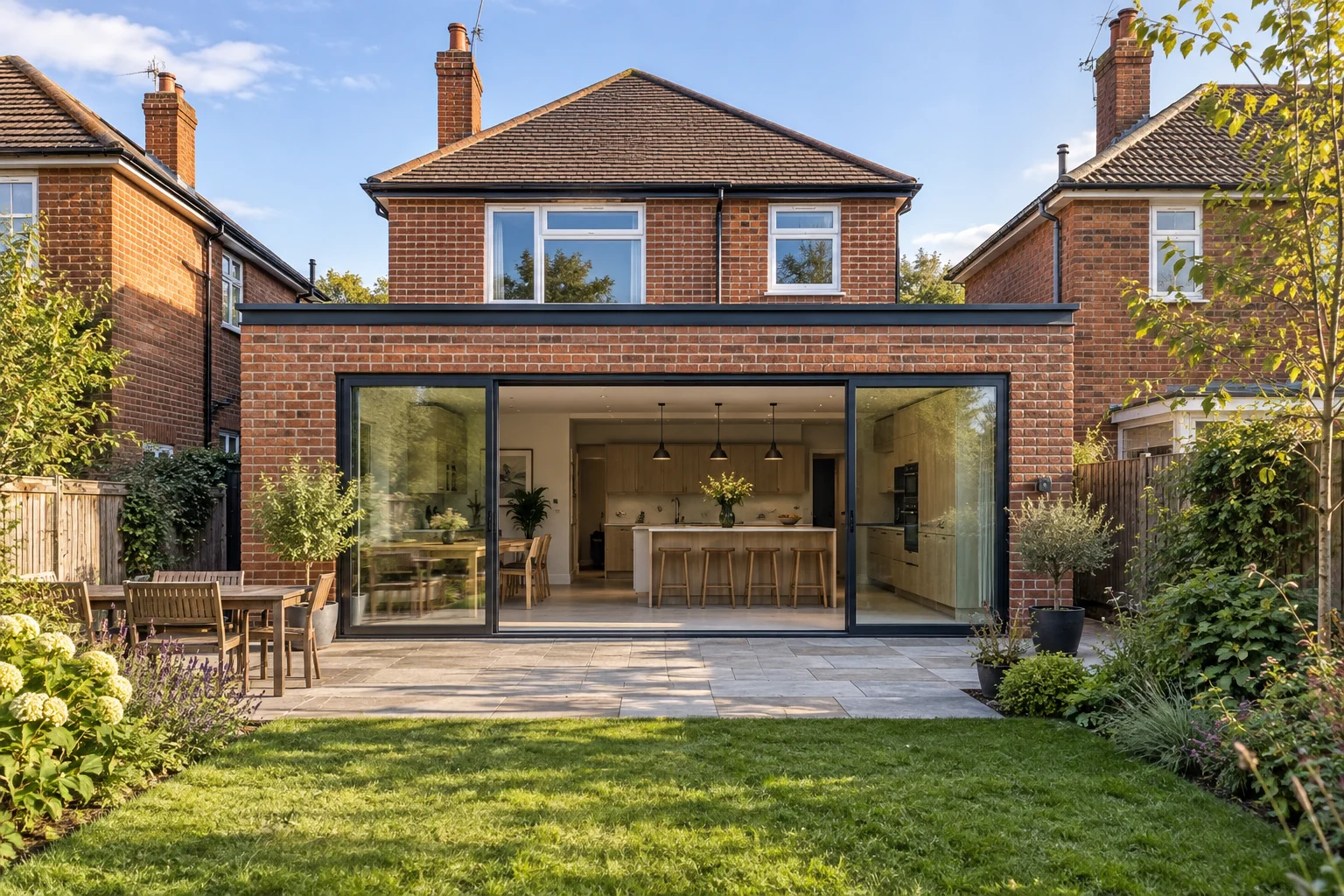
Architectural concept · not a completed company project
NOTTINGHAM · HOUSE EXTENSIONS
House extension builders in Nottingham.
Create the space your home is missing. Talk to Design N Build about a rear, side, kitchen or two-storey extension, with your layout, specification and construction scope considered together.
DESIGN & BUILDConnect your plans and building work
CLEAR PROJECT SCOPEDiscuss the detail before you appoint
TALK TO OUR TEAMCall, WhatsApp or send an enquiry
YOUR PROJECT, CLEARLY DEFINED
Define the extension and the work inside your existing home
Discuss a rear, side, wrap-around or two-storey extension with Design N Build. The quotation needs to describe the finished space, the connection to the existing house and any rooms that change as a result. A price for the new structure alone will not tell you the cost of a completed kitchen and living area.
Build a comparable extension scope
Part of the project
What to define
Why it affects the quotation
New structure
Footprint, roof form, openings and the current structural design.
Different designs and ground conditions involve different construction packages.
Connection to the house
Structural opening, altered services, floor levels and making good.
Work in existing rooms may extend beyond the new footprint.
Kitchen and glazing
Chosen suppliers, product specifications, measurement and installation responsibilities.
A supplier price may exclude building preparation or fitting.
Completion
Floor finishes, decoration, lighting, drainage and affected garden areas.
A shell and a ready-to-use room are different outcomes.
Choose the result before comparing totals
For a kitchen extension, sketch how cooking, dining and garden access will work on an ordinary day. Include the original kitchen in that sketch. If it becomes a utility room or study, its removal, alterations and new finish belong in the project brief. For a two-storey proposal, show both floor plans so access to the new bedrooms is considered alongside the living space below.
Send the same drawing revision and finish schedule to every contractor you ask to price. Identify selected products, provisional allowances and exclusions. Ask whether professional fees, application charges and VAT are included in the figures supplied. Keep a separate allowance for unresolved work; it is not the same as money reserved for optional upgrades.
Resolve permission and site access for the actual property
Some house extensions can fall within permitted development rights, subject to detailed limits and conditions. That is not a blanket exemption. Use the current Planning Portal guidance and the relevant local authority to check the particular house and proposal. Building regulations approval is a separate consideration, and work near boundaries may also require party-wall advice.
Photograph the route from the road to the proposed work area, not only the rear elevation. Explain whether materials must pass through the house, whether a side passage is shared and where you expect deliveries or waste containers to stand. Do not assume a public road or a neighbour’s land can be used without the necessary arrangements. Include reinstatement of disturbed paving or garden areas in the agreed scope.
Make your first enquiry useful
Postcode, existing and proposed plans, and the latest drawing revision.
Approximate proposed footprint and how the adjoining rooms will change.
Kitchen, rooflight and glazing selections, or a clear list of undecided items.
Rear-access photographs, known drainage information and whether you plan to remain at home.
What should I include in my first house extension enquiry?
Include your postcode, the type of extension, available drawings and the rooms you want to create. Explain what will happen to adjoining rooms, particularly an existing kitchen or dining room. Photographs of the rear or side access are useful, as are known drainage details and selected glazing or kitchen specifications. State whether you intend to remain at home. Those details help the team identify what can be discussed now and what further information is needed before pricing.
Can you price an extension from planning drawings alone?
Planning drawings can support an initial discussion, but may not define enough detail for a complete construction quotation. Structural information, floor and roof build-ups, drainage, service alterations and finish selections can affect the package. Ask what additional information is needed and which assumptions any preliminary figure uses. A price based on unresolved details should not be treated as equivalent to a quotation for a fully specified extension.
Which type of extension is right for my house?
The right option depends on the room you need, the existing layout and the property constraints. A rear extension may improve the garden connection; a side extension may add practical space; a two-storey proposal affects accommodation on both floors. None is automatically the best or cheapest choice. Show how you intend to use the rooms, including those you retain, then assess the design and permission route before asking for a defined construction price.
Do all house extensions require planning permission?
No. Some extensions to houses can be permitted development, but only when the proposal and property meet the applicable conditions and limits. Rights can also be restricted, so an example next door does not confirm your position. Check current Planning Portal guidance and the relevant local authority, using the full property address. Building regulations and any other necessary permissions or agreements remain separate checks. Do not rely on a general website answer as approval for your extension.
Is building regulations approval the same as planning permission?
No. Planning permission concerns whether a proposal needs permission and is acceptable under the planning system. Building regulations concern the requirements applying to the building work. An extension may need both, and a planning decision does not settle the building-control requirements. Ask your project advisers which route applies and who will coordinate the information and inspections. Keep the resulting documents with your project records rather than treating one approval as covering every responsibility.
Can an extension include changes to my existing kitchen and dining room?
Yes, connected work in the existing house can be discussed as part of the extension brief. Specify which fittings are removed, whether openings change, what happens to services and how floors, walls and ceilings will be finished. Include the kitchen supplier’s role and any products you will purchase separately. The quotation should describe the old and new spaces together; a price for the extension structure should not be assumed to include a completed refurbishment of adjoining rooms.
More project questions 18 answers
Will I be able to stay in the house during the extension?
The answer depends on the scope, the proposed sequence and the facilities your household needs. External work and later internal connections can affect the home differently. Tell us which rooms must remain usable, whether anyone works from home and whether there are children, pets or particular access needs. Discuss the stages when cooking, washing or circulation may be interrupted and what temporary arrangements would be required. Remaining at home should be an agreed project-specific plan, not a blanket promise. Any separate accommodation or temporary-facility commitments should be made against confirmed information. Include occupancy requirements at enquiry stage so they are considered alongside the construction package from the beginning.
How long will a house extension take to build?
A reliable programme must reflect the particular design, construction scope, information readiness, approvals, access, procurement and confirmed availability. The label single-storey or kitchen extension is not enough to establish a duration. Tell us your preferred dates and the reasons behind them, then discuss the dependencies that affect the project. Product orders, design decisions and the timing of internal connections may each influence the sequence. Changes or unexpected findings can also require review. We do not present a generic online duration as a commitment for your home. The appointment and agreed programme should be confirmed directly once sufficient project information is available to make those dates meaningful.
What is normally included in an extension quotation?
The contents should be defined for your appointment rather than assumed from a standard label. The quotation may need to address early site work, the main construction, internal connections, service alterations and finishes, but the exact package depends on what you are commissioning. Kitchens, decoration, flooring, glazing and outside reinstatement require clear boundaries. Some may be included, allowed for provisionally or arranged separately by you. Ask which drawings and specifications the price follows and review the stated assumptions and exclusions. The most useful quotation is one you can compare with your intended finished result. Tell us that result in enough detail for the proposed package to be understood.
Why can two quotations for the same extension look very different?
They may not describe the same work even when they refer to the same footprint. One could include internal remodelling, a developed finish or external reinstatement that another excludes. Different drawing revisions, product allowances and assumptions can also change the package. Compare the scope, supporting documents and level of completion before treating the totals as directly equivalent. Clarify applicable tax treatment, client purchases and professional appointments. Ask how variations and discoveries are handled. A consistent brief makes comparison more useful, but questions may still be necessary. Send Design N Build the construction outcome you want priced so the offer can be assessed against a defined requirement rather than the extension's name alone.
Can I buy the glazing myself and have it included in the build?
That arrangement can be discussed, but the responsibilities need to be established before ordering. Identify the supplier, proposed product and who will confirm final dimensions. Agree who installs the glazing, what surrounding construction and finishing are included and how delivery or storage will work. A direct purchase does not automatically add every related task to the builder's appointment. It also does not remove the need to coordinate the product with the design and prepared opening. Share specifications and supplier requirements with the team. Where measurements depend on a later construction stage, the programme should recognise that dependency rather than assuming an early order can be placed safely against preliminary information.
Should the kitchen design be completed before the extension starts?
The kitchen information needs to be developed far enough, at the relevant stages, to coordinate the building work that depends on it. Layout, appliance positions, extraction, lighting, service routes and floor arrangements can affect construction decisions. Not every decorative selection necessarily has to be final at the same moment, but unresolved choices should be identified. Tell us which supplier is involved and obtain the technical information they require or provide. The project should establish who installs the kitchen and what preparation belongs in the building package. A coordinated sequence is more useful than a universal rule that either every detail must be selected immediately or all kitchen decisions can wait until the extension is built.
Can a side extension remove the only route to my garden?
A proposal may alter existing access, which is why the current use of the side space needs to be part of the brief. Explain how you move garden equipment, bins, deliveries or other items now and what access must remain afterwards. The design should consider those functions alongside the additional accommodation. Construction access also needs a separate practical plan. Whether a particular arrangement is appropriate depends on the property and the assessed proposal, not the service label. Bring photographs and relevant site information into the enquiry. That allows the next discussion to consider how the extension will be built and how the household will use the property after completion.
How are drains or services under the proposed extension dealt with?
Their position, ownership, condition and the proposal's requirements need appropriate assessment. Supply any survey or record information you have and identify known inspection points or service routes. The responsible professionals, utility owners or specialists may need to provide input before the design and construction package can be settled. Do not assume an item can simply be moved or covered because it conflicts with the preferred layout. The quotation should state the information relied on and distinguish defined work from matters still requiring investigation. We can discuss the building scope against the coordinated proposal, including related internal alterations and making good, once the relevant responsibilities and requirements are understood.
What if the ground conditions differ from what was expected?
The project arrangements should provide a route for reporting the finding, obtaining the appropriate assessment and agreeing the response. Record the condition and identify what work or information is needed before the affected stage proceeds. The discussion should address any cost and programme consequences rather than relying on an informal assumption. A construction quotation cannot be treated as proof of concealed conditions that have not been established. Equally, the response should relate to the actual finding and the agreed appointment. Ask how this process will work before instructing the project. It gives both parties a clearer basis for dealing with site-specific information as it becomes available during the extension work.
Can the new extension floor run continuously into the original house?
That appearance can be explored, but the existing levels, construction and chosen finish need coordination. The relevant professionals and suppliers should establish the build-up and preparation requirements. A surface that looks similar to another product may have different installation needs or thickness. Decide how much of the original room you want included and whether the intention is to match, replace or create a deliberate transition. The quotation should reflect that boundary. If a separate flooring installer is involved, obtain their requirements and identify who prepares the underlying areas. This allows the building scope to support the desired finish without assuming that a continuous-looking floor is achieved by surface selection alone.
How should I plan lighting in a kitchen or family extension?
Begin with the activities and furniture layout: food preparation, dining, reading, work, circulation and the way the garden connection will be used. Provide that brief to the appropriate designer or electrical professional so the specification can be coordinated with the building. Rooflights, ceilings, kitchen furniture and structural elements may affect the available arrangement. Identify which fittings are selected and who supplies them. The construction package should state the relevant preparation and installation responsibilities. This page does not prescribe an electrical design for your property. The useful next step is to bring your preferred room layout and lighting references into the project discussion before surrounding construction decisions limit the choices.
Can I add a utility room or cloakroom to the extension project?
Those spaces can be discussed where they form part of the intended design. Explain their purpose, the users and whether they sit within the new addition or in an existing room being converted. Their layout and service requirements need coordination with the rest of the property. A utility room may also replace functions lost when the kitchen changes, so consider storage and appliance needs together. The quotation should describe the preparation, fittings, finishes and installation responsibilities rather than relying on the room name alone. Where products are supplied separately, provide their specifications. Including the practical rooms in the initial brief helps the extension work as a complete household improvement.
What should be agreed about the garden and patio after building?
Define the external condition you expect and identify which work belongs in the extension appointment. The new footprint may affect existing paths, patio areas, planting, steps and the immediate access to the garden. Some reinstatement may form part of the building package, while wider landscaping may be a separate commission. Distinguish those arrangements clearly. If the outside work will follow later, agree the interim condition around the completed extension. Do not assume that use of an area during construction means a particular landscaped finish is automatically included. Photographs and a simple description of the intended external result can make the quotation discussion much more precise.
Is a two-storey extension priced as two identical single-storey projects?
No useful quotation should be prepared on that assumption. A two-storey proposal has its own structural, roof, service and layout relationships, as well as interfaces with the existing upper floor. It needs assessment as a complete project. The ground-floor and upper-floor accommodation may have different uses and different finishing requirements. Supply both layouts and explain all affected rooms. The quotation should follow the actual design and scope rather than multiply a generic price attached to a simpler extension type. We can discuss the relevant construction service and the information needed for that package, including occupancy, internal connections and the condition in which the original rooms will be left.
Can we change the layout after the extension work has begun?
A proposed change needs review before it becomes an instruction. Identify the revised layout, the reason for the change and the documents or products affected. The consequences may extend to structural information, approvals, supplier orders, services and finishes. Appropriate professional input may be needed, and completed work or existing commitments can influence cost and timing. The project agreement should explain how changes are described, priced and authorised. Do not assume a small movement on a plan has only a small construction effect. Raise preferences as early as possible so they can be considered while options remain open, with the agreed scope and programme kept understandable to everyone involved.
How can we keep the extension within our overall budget?
Define your essential accommodation and distinguish it from flexible specification choices. Develop the scope sufficiently to identify what belongs in the building contract and what you are purchasing or appointing separately. Review allowances, exclusions and optional work instead of concentrating on the headline total. Where alternatives are proposed, ask about their consequences for adjoining work as well as the immediate price difference. Keep decisions coordinated before orders and construction depend on them. No website can guarantee that an unassessed design fits a particular budget. A clear brief, a transparent quotation and an agreed variation process give you a more useful basis for making decisions as the project develops.
What evidence should I request before appointing an extension builder?
Request information relevant to the proposed appointment and assess the actual documents rather than relying on broad marketing claims. You may want to review the written scope, terms, applicable insurance information, relevant experience and the arrangements for professional responsibilities and completion records. Where references or a portfolio are important to your decision, ask for evidence that relates to genuine work. The concept images on this website are labelled illustrations, not a completed-project record. Clarify who will carry out, design and coordinate the work within the package. The right questions help establish what is being offered and which responsibilities remain with the client or separately appointed professionals.
What is the next step when we are ready to discuss our extension?
Contact Design N Build with the full postcode, your current plans and a concise description of the accommodation and finish you want. Include relevant specifications and reports, and identify any information still being developed. Tell us whether you are seeking an early design-stage conversation or a quotation for a defined construction package. Call for a discussion, use WhatsApp for an introduction with photographs, or complete the project enquiry form. The team can then address suitability and the appropriate next appointment. Confirm any visit terms and eventual construction proposal directly. An enquiry is the start of that process; it is not an automatic booking, fixed-price acceptance or reserved construction date.
Commission an extension that changes how your home works
Start with the space you are missing
Your extension should answer a specific problem in the existing house. You may want somewhere the family can gather without taking over the kitchen, a ground-floor room for a changing household, or a larger dining space with a direct garden connection. Tell Design N Build what is missing and how you expect the new accommodation to be used. We can discuss the extension building service, the stage of your design and the information needed to define a construction package. The starting point is the life you want the room to support, not an arbitrary number of additional square metres.
For a property in West Bridgford, use the [local house-extension enquiry guide](/house-extensions/west-bridgford/) to connect the current Rushcliffe assessment, site access and retained-room scope with your pricing pack.
Think about the existing rooms as part of the commission. If the new extension takes over cooking and dining, the original kitchen may become a utility, study or circulation space. If an upper-floor extension adds a bedroom, the landing and bathroom arrangements may also need attention. These changes affect the usefulness of the whole house. Include them in the initial brief so the proposed work is considered as a connected alteration rather than a new structure attached to an unresolved interior.
Move towards a buildable, priced scope
Some clients arrive with a developed drawing set; others need to establish a sensible design direction first. Both stages can start with an enquiry, but they call for different next steps. Tell us whether you need discussion of the construction work, design coordination or the relationship between appointments already in place. Any visit and associated terms should be agreed directly. A meaningful quotation follows an understood scope, appropriate information and a clear account of the finish you expect. Contact our Nottingham team with your postcode and an outline of the extension to begin that process.
An extension brief joins the new building, the existing rooms and the outside space.
Choose the extension form around your property and priorities
Compare the accommodation each option can deliver
Rear, side, wrap-around, single-storey and double-storey extensions are useful descriptions of different forms, but the label does not establish which is suitable for your property. The important comparison concerns the rooms created, the connection to the house, the remaining external space and the design requirements. Explain the accommodation you need before committing to a preferred form. That allows the design assessment to consider whether the chosen direction genuinely addresses the brief or simply resembles an image you like.
A single-storey proposal might transform the ground floor without changing the accommodation above. A two-storey proposal brings a different relationship between floors and can affect the upper layout as well. A side or wrap-around arrangement may present opportunities and constraints different from a straightforward rear addition. These are matters to assess against the actual building and site. We can discuss the relevant construction service once the nature of the proposal and the information available are clear.
Keep alternative scopes comparable
When exploring options, ask for their boundaries to be described consistently. One layout may include remodelling the original kitchen while another assumes it remains untouched. One may require more external reinstatement or a different roof connection. Without those distinctions, comparing only size or a headline price can be misleading. Share the options and identify what each is intended to achieve. The next conversation can then focus on the construction implications and the information needed to evaluate them, rather than treating different projects as if they were interchangeable versions of the same package.
Build a rear extension that connects the house and garden
Give the new room a clear relationship to the old one
A rear extension can reorganise the busiest part of a home. Consider how people will enter the room from the hall or existing kitchen, where furniture will sit and which routes must stay clear. The position and width of the connection to the original house should be developed with the proposed layout, not added after the external shape has been settled. Tell us about the internal changes you expect so the construction discussion addresses the complete ground-floor arrangement.
The garden-facing side deserves the same attention. A glazed opening might frame the view or provide access for daily use, but it also needs to work with seating, storage and circulation. Think about the position from which you will enjoy the outlook and how doors operate when furniture is in place. Bring these practical requirements into the design brief. The aim is an extension that functions on an ordinary winter evening as well as it photographs with the doors open in summer.
Describe what happens outside the new wall
An extension changes the position of the house's edge, which may affect paths, planting, patios, steps and existing external services. Identify the outside work you want included and what will be handled separately. If landscaping will follow later, agree a suitable interim condition for the immediate area around the extension. This is part of defining the purchase, not an optional detail to discover after construction. Send photographs showing the rear elevation, access and garden so the first enquiry includes the setting in which the extension will be built.
Use a side extension to improve more than floor area
Make narrow space earn its place in the layout
A side addition may provide a different kind of opportunity from a deep rear extension. It could help reorganise a kitchen, accommodate practical rooms or improve movement through the ground floor. The right brief depends on the existing house, the available site and the design position. Tell us which rooms feel constrained and what functions you would like to relocate. Useful accommodation can come from a more effective arrangement as well as additional width, so the new space should be planned together with the rooms it serves.
The extension may change the route between the front and rear of the property. Where the current side space is used for deliveries, garden access or storage, describe that use before the design assumes the area is spare. Consider how those functions will be handled afterwards and during construction. This helps avoid an attractive interior solution creating an unresolved practical problem outside it. The building package should recognise both the finished layout and the access arrangements needed to deliver it.
Resolve the relationship to the boundary properly
The site boundary, neighbouring structures and the proposed roof or wall arrangement need property-specific assessment. Do not infer a legal or planning position from the dimensions of an apparently similar extension elsewhere. Share the documents and known constraints relevant to your site, and identify who is advising on them. Our construction discussion will follow the assessed proposal and the information supplied. This keeps the quotation linked to a defined design rather than an unverified assumption that a strip of land can be built on in any preferred way.
Bring a wrap-around extension together as one composition
Plan the corner, circulation and new room sequence
A wrap-around proposal can change several relationships in a house at once. The rear and side portions need to work together rather than feel like separate additions. Consider how you will move from the original hall into the new accommodation, where the practical rooms belong and which areas benefit from an outlook. A kitchen, dining space and family area may share one larger volume while retaining distinct functions. Explain those intended uses so the design can give each part a purpose.
The original rooms also need a convincing role after the work. A space that once looked outside may become internal, and an existing doorway may no longer sit in the most useful position. Discuss daylight, storage and circulation in these retained areas alongside the new addition. The construction scope should identify the alterations, preparation and finishes required inside the original house. Otherwise the main extension can be priced while an important part of the actual transformation remains undefined.
Coordinate the roof and external appearance
Because more than one elevation is involved, the roof form, drainage arrangement and junctions need deliberate coordination. The design information should establish how the extension meets the existing building and how different components relate. The contractor's package can then be discussed against that information. Bring references for the materials and appearance you prefer, but distinguish them from a completed specification. Where several design options remain open, explain which decisions are settled so cost discussions reflect the real stage of the proposal rather than assuming every interface has already been resolved.
Add accommodation on two levels with a coherent whole-house plan
Make the upper-floor arrangement as strong as the ground floor
A double-storey extension should be assessed as a change to the whole property. The additional rooms above need useful access, appropriate relationships to existing bedrooms and a sensible arrangement of bathrooms or storage. Consider the position of the landing and any rooms through which access is proposed. Extra floor area is less valuable to the household when circulation compromises privacy or leaves existing spaces awkward to use. Explain the accommodation you need on each level before treating the external footprint as fixed.
Explore [double-storey extension construction](/double-storey-extensions/) when the upper landing, stacked room functions and two-floor occupation arrangements need a dedicated proposal.
At ground level, the extension may be serving a different objective, such as a larger kitchen or family room. The two layouts need to work together with the structure, services and external design. A choice made on one floor can influence the other. Provide the complete current plans when enquiring, not just the floor you consider the main improvement. This gives the construction conversation the context needed to discuss the proposed package and identify further information required.
Include the affected rooms and connections
Upper-level construction can involve work around existing walls, roofs and internal finishes. The scope should make clear which rooms are affected and the condition they will be left in. Also discuss whether the house will be occupied and which areas must remain accessible through different stages. The appropriate arrangements depend on the assessed project and agreed sequence. We can discuss the building service and the practical questions to resolve without promising that a two-storey addition can be delivered as an isolated activity with no effect on the original home.
Create a kitchen extension with the building and furniture aligned
Give the kitchen layout a place in the early brief
A kitchen-led extension should be shaped around more than the furniture catalogue. Describe how many people usually cook, whether dining needs to be formal or informal and what you want to store out of sight. The position of appliances, working areas and circulation can influence windows, doors and the connection to other rooms. Bring these requirements into the design discussion before assuming the building shape and the kitchen can be settled independently.
Your kitchen supplier's layout should be coordinated with the current building information. Important dimensions, extraction requirements, appliance connections, lighting and floor build-ups need compatible assumptions. Identify who is supplying and installing the kitchen and what construction preparation is included in our proposed package. A quotation that covers the extension structure does not automatically include every component needed to deliver a supplier's design. Clarifying those responsibilities makes the appointment more understandable and helps avoid gaps between trades or suppliers.
Include the spaces that support the kitchen
The best kitchen arrangement for your household may depend on a utility area, pantry, cloakroom or improved entrance nearby. These spaces can keep the main room calmer and more useful, but they need their own scope and service coordination. Tell us whether the original kitchen is being retained temporarily, removed completely or converted to another use. That affects the sequence and the making-good work. Contact us with your kitchen ideas and the existing house layout so the extension enquiry addresses the connected set of rooms, not just the new units.
Turn a single-storey addition into a complete ground-floor improvement
Balance the new accommodation with the retained rooms
A single-storey extension can create a substantial change without adding an upper floor, but the success of the project still depends on how the existing accommodation works afterwards. Consider the room that connects to the extension, the route from the entrance and the position of stairs or internal doors. Where furniture or daily movement is affected, include that information in the brief. A new room should extend the usefulness of the house rather than leave an awkward passage between old and new.
Think about the intended ceiling, openings and outside relationship as part of the same design. The roof form, window arrangement and internal layout influence one another. A preferred appearance should be developed with the relevant design professionals and translated into information suitable for the proposed building package. We can discuss the construction services against that brief, including the extent of internal alterations and the finishes that belong in the quotation.
Establish the final condition clearly
A single-storey shell ready for a separate fit-out differs from a finished kitchen and family space. Decide which appointment you want us to consider. Specify the role of flooring, decoration, joinery, lighting, fitted items and external reinstatement rather than leaving them under a general expectation of completion. If some products will be selected later, identify them as unresolved choices. The resulting quotation can be reviewed against an understandable outcome, with optional work and separate purchases visible instead of hidden behind the name of the extension type.
Remodel the original house as part of the extension
Plan the new opening and the room beyond it
The opening between existing and new accommodation is often central to the project. Its position, form and relationship to furniture affect how connected the rooms feel. Any structural alteration must follow the appropriate assessment and design; its specification cannot be established from a website or a casual description. Provide the relevant drawings and identify who is responsible for the technical information. The construction package should also describe surrounding ceilings, walls, floors and services so the finished interface is not left ambiguous.
Where the original kitchen, dining room or hallway changes use, record the work needed there. Removing old fittings, altering services, preparing surfaces and finishing a room for its new purpose are distinct tasks. A plan may show the new label without conveying all of that work. Explain your expectations during the quotation discussion. This makes it easier to distinguish included remodelling from work the client intends to undertake separately after the extension is completed.
Preserve features that matter to you
Extensions do not always require every adjoining feature to be replaced. You may want to retain a fireplace, an existing floor or particular joinery. Identify those items and agree whether they remain in place, need protection or should be removed for reuse. The design of the junctions may need to respond to them. Making these priorities visible early helps the project balance improvement with preservation and allows the building scope to recognise the care and preparation required around retained elements.
Specify a roof that supports the intended interior
Discuss height, shape and the sense of space together
The roof influences the extension inside as well as outside. The intended ceiling form, relationship to the original building and opportunities for daylight should be considered with the room layout. Bring references to explain the atmosphere you want, then develop the proposal through the appropriate design process. A picture of a pitched or flat-looking roof does not define the structural design, build-up or drainage arrangements needed for your property. Those details must be coordinated before they form a reliable construction specification.
Rooflights and other openings should be positioned for the activities below them. Consider where you will cook, sit or work, and how light reaches the retained parts of the house. The relevant product information also needs to align with the roof design and installation requirements. Explain whether a supplier has already been selected and who will provide the coordinated details. This keeps the quotation tied to an actual package instead of a loosely described feature that different parties interpret differently.
Include junctions, drainage and finishing responsibilities
Ask for the scope to describe the connection to the existing building and the associated internal and external finishes. The roof package may involve interfaces with glazing, wall finishes and rainwater handling that require input from several parties. Identify those responsibilities and the documents on which the work will be based. We can discuss construction against the agreed design, but we will not present an unassessed standard roof detail as appropriate for every extension. A well-defined appointment makes these interfaces visible while the decisions can still be coordinated.
Coordinate glazing before surrounding decisions become fixed
Select the opening for the way you will use it
A large glazed opening can give an extension a strong garden connection, but different arrangements suit different uses. Think about the route used on an ordinary day, furniture positions and how the opening will operate when the room is occupied. The visual preference is one part of the brief. Product dimensions, installation requirements and the relationship to the floor and structure need coordination as well. Tell us which supplier information is already available so the construction discussion can address a real selection rather than an undefined glazing allowance.
Windows elsewhere in the extension deserve equal attention. They may provide an outlook from a working area, bring light into a practical room or help the external composition. Their position should relate to the internal fittings and furniture. A window shown in a general reference image can conflict with a kitchen layout or a storage requirement when translated directly. Bring the room uses into the design conversation so the openings contribute to a coherent plan.
Agree measurement, ordering and installation boundaries
Establish who confirms final dimensions, who places the order and who is responsible for installation and surrounding work. A client purchase still needs coordination with the building package. Where measurement follows a construction stage, the programme should recognise that dependency rather than assuming the product can be ordered against an earlier sketch. Discuss delivery, storage and the process for reporting discrepancies. These agreements help ensure that the selected glazing and the prepared opening meet on the same basis, with responsibilities understood before either becomes difficult to change.
Include foundations and ground-related work in the assessed scope
Price from relevant information, not a guessed depth
Ground-related work is specific to the site and proposed structure. The appropriate design and assessment should establish the requirements; a website cannot prescribe a foundation solution from the name of the extension alone. Supply available reports, survey information and any relevant records when making the enquiry. Identify who is providing the technical design and what further investigation may be needed. The quotation discussion can then distinguish defined work from items that remain subject to assessment.
Existing structures, access, known services and the location of the extension all influence how the package is described. Tell us about previous work or conditions you know of, but provide the underlying documents where possible. A photograph may explain access or surface conditions without revealing what is below ground. The appointment should state the information it relies on and the process for dealing with findings that differ from those assumptions. This is a more useful basis for commissioning than an apparently precise allowance with no stated context.
Connect the early work to the final design
The design of the extension and the work beneath it must remain aligned. Changes to the footprint, structure or services can affect decisions already made for early construction stages. Keep revisions visible and obtain the appropriate review before treating a change as a simple adjustment. Ask how design queries and unexpected findings will be communicated under the appointment. The aim is to build from coordinated information and a clear approval process, not to substitute improvised decisions for the professional input the project requires.
Bring drainage and existing services into the extension brief
Identify what is already in the proposed work area
The space where an extension is planned may contain drains, inspection points, incoming services or other existing infrastructure. Supply any relevant survey or record information and identify known positions during the enquiry. These elements should be assessed as part of the project, not treated as details to resolve only after the external layout is fixed. Where an authority, utility owner or specialist has requirements affecting the proposal, establish who will obtain and coordinate the necessary information.
A drawing of the desired room arrangement does not automatically describe all alterations to the existing services. The kitchen, bathrooms and practical rooms may need routes that pass through retained areas of the house. Discuss the extent of that work and the associated making good. This helps the proposed quotation address the complete connection between the extension and the existing home instead of concentrating only on the new external shell.
Keep access and future use in view
The design should recognise the practical access requirements for installed components and existing infrastructure. Concealing or moving an item is not simply an aesthetic decision. The appropriate parties need to establish what is acceptable and how the arrangement should be detailed. Bring supplier and technical requirements into the discussion before finishes are selected around them. We can consider the construction package once those responsibilities and requirements are understood, ensuring that the service work, room layout and finishing scope are being discussed as parts of one coordinated project.
Plan comfort as part of the extension specification
Consider the new room and the existing home together
An extension should be comfortable for its intended use, not only visually appealing. The building fabric, glazing, ventilation and heating arrangements need consideration through the appropriate design and specification process. Tell the team how you expect to use the space and what existing arrangements are known. A larger room or a change in layout can alter the requirements that the design needs to address. The construction quotation should follow that information rather than relying on a generic promise about how every extension will perform.
Product choices can influence more than appearance. A preferred glazed area, floor finish or heating arrangement may have implications for adjacent components and installation requirements. Supply the selected specifications early enough for coordination. Where you are comparing alternatives, ask for their effect on the building package to be explained alongside the purchase cost. This helps you choose an option with a fuller understanding of what its installation involves.
Make the operating details part of handover
The completed space may include equipment or controls that are new to the household. Identify which product information and explanations will be provided and who is responsible for them. Where another specialist supplies or commissions part of the work, coordinate the handover with that appointment. The objective is not to claim an unverified energy saving or a universal comfort result, but to deliver the agreed construction and associated information on a clear basis. Bring your comfort priorities into the first conversation so they inform the specification rather than appearing only after the finish has been chosen.
Match floor levels and finishes across the old and new rooms
Resolve the junction before selecting only the surface
A continuous-looking floor can help an extension feel integrated, but the underlying levels and build-ups must be coordinated. Discuss the intended relationship between existing and new areas and identify any changes of level in the property. The relevant design and product information should establish the construction requirements. A chosen finish may look similar to another option while needing different preparation or a different overall build-up. These details belong in the scope before door thresholds and adjoining work are treated as settled.
Where the original floor will remain, agree how the new area is intended to meet it. Matching, contrasting or using a deliberate transition can produce different results and require different preparation. Tell us which appearance you are seeking and how much of the existing room should be included. The quotation can then describe the work boundary clearly rather than assuming that a new extension floor automatically includes replacement throughout the ground floor.
Coordinate the flooring appointment with the build
If a separate supplier or installer is involved, obtain their preparation and installation requirements and share them with the project team. Establish who checks the underlying conditions, who provides the product and who undertakes the final installation. The programme should reflect those responsibilities. A delivery date alone does not establish that the space is ready for a particular finish. We can discuss the building work needed to support the agreed arrangement so the extension package and the flooring appointment fit together without leaving preparation or making good unallocated.
Include the smaller rooms that make a large extension practical
Give the utility, pantry and cloakroom a proper brief
An extension can make space for practical functions that are difficult to accommodate in the original house. A utility area may take laundry out of the kitchen, a pantry may improve food storage, and a cloakroom may support family life or visitors. Decide which functions matter to you and how often they will be used. These rooms deserve more than leftover space on a plan. Doors, fittings, service routes and circulation need to make the intended use comfortable.
Tell us whether the practical accommodation belongs in the extension itself or in an original room that changes use. The second arrangement can involve substantial preparation even where no new floor area is created. Existing fittings may need removal, surfaces may need attention and services may need alteration. Describe the intended finished room so the proposed quotation includes the relevant construction work rather than treating the change of label on a drawing as a complete specification.
Make everyday storage part of the purchase
Open-plan extensions can lose the cupboards, wall space or corners that previously held household items. Consider coats, cleaning equipment, pet supplies, toys and occasional-use furniture before the layout is finalised. Built-in storage or a more considered practical room may be more useful than additional uninterrupted wall length. Where joinery is included, identify who designs, supplies and installs it. Where it is a later purchase, ensure the building brief provides the necessary space and coordination. The purpose is a finished extension that remains organised in daily use rather than depending on an empty-room photograph.
Manage planning questions before relying on an assumed permission
Establish the position for the particular house
Some house extensions may fall within permitted development rights when the relevant conditions and limits are met; others require planning permission. Restrictions and circumstances vary, so the answer must be established for the property and exact proposal. Do not infer your position from a neighbour's project or a simplified size rule. Ask the appropriate professional or local planning authority for advice on the actual design and supply the relevant documents to the construction team.
If an application has already been decided, provide the decision and associated drawings, including the current status of any conditions. If the proposal has changed since those documents were prepared, make that clear. The information used for construction pricing should not silently diverge from the design being considered for approval. We can discuss the building package and your project stage, but an enquiry is not a confirmation that the proposed extension has all necessary permissions.
Allocate submission and response responsibilities
The project team should identify who prepares and submits planning information, who responds to questions and who communicates resulting design changes. Those responsibilities may sit in a separate appointment or within an expressly agreed package. Clarify them before proceeding. Where other property-specific restrictions or consents are relevant, include them in the document review. A clear route through the required checks helps the programme and quotation remain realistic, with the construction work based on an understood proposal rather than an expectation that approvals will somehow be resolved later.
Keep building regulations separate from the planning decision
Coordinate the information needed for compliance
Building regulations and planning permission address different matters. An extension's planning position does not, by itself, establish that the technical requirements for construction have been satisfied. The relevant design information and approval or inspection arrangements need to be addressed for the actual work. Identify the appropriate professionals and approval route for your project, and make clear which party is responsible for coordinating the required information. The building appointment should describe how it relates to those arrangements.
Technical decisions can affect the layout, materials and components selected for the extension. Bring that information together before orders or construction stages depend on it. If a supplier's detail or a design revision changes an assumption, the appropriate review may be required. The quotation discussion should distinguish a developed technical package from a proposal still awaiting important input. This gives you a more reliable understanding of what can be priced and what remains unresolved.
Plan for inspections and completion information
Ask who arranges relevant inspections, keeps the associated records and provides the documents required at completion. These responsibilities should be identified early enough to support the construction sequence. The appropriate requirements depend on the work and the route being followed, so this page is not an exhaustive project checklist. Use the official guidance and your appointed professionals for the specific position. Our building conversation should connect the agreed construction scope to the responsibilities and information needed around it, rather than treating documentation as a separate problem to reconstruct after the work ends.
Treat neighbour and boundary matters as address-specific questions
Identify issues before the site setup relies on them
An extension may bring construction close to a boundary or neighbouring structure. Access, shared features and the proposed work can raise questions that need advice appropriate to the property. Tell us about known agreements, restrictions and concerns at the enquiry stage. Supply the available documents and establish who is advising on the relevant position. Neither a friendly conversation nor the appearance of similar nearby work should be used as a substitute for checking the requirements that actually apply.
The construction plan should not assume permission to store materials, erect equipment or move through an area controlled by someone else. Where additional access is proposed, identify the arrangements and responsibilities before relying on it. This can affect the practical setup and programme, so it belongs in the early project discussion. A clear account of what is available allows the building package to be considered against real conditions rather than an optimistic sketch of the site.
Communicate the practical effects through an agreed route
Neighbours may need information about access or work affecting shared arrangements, but the content and timing should reflect the actual programme and any relevant professional advice. Agree who will communicate and what has been confirmed. Avoid promising dates or arrangements that are still under discussion. For your own project, record the important constraints and make sure they reach the people preparing the design and quotation. This supports a more orderly construction brief without making unsupported assurances that every boundary or neighbour issue has a simple standard solution.
Organise deliveries and working access for your extension
Look at the journey from the road to the work area
The extension may be at the rear of the property, but materials and equipment still need a workable route to it. Share photographs showing entrances, side passages, steps and other constraints. Tell us which routes the household needs to keep using and where parking or deliveries require particular arrangements. The site setup must be considered against the actual access, not a generic assumption that every project has space beside the house.
Where materials must pass through retained areas, protection and sequencing become important parts of the scope. Explain any surfaces or fittings requiring particular care and ask what needs to be moved before the start. Storage should be planned so it supports the work rather than blocking circulation or occupying essential household space. These arrangements can influence the practical construction package, which is why they should be visible when the project is assessed.
Define waste handling and reinstatement responsibilities
Construction also needs an agreed approach to waste and to the condition of the areas used during the work. The quotation should describe the relevant responsibilities and any assumptions affecting access or permissions. If temporary routes or storage areas will need reinstatement, identify the intended outcome. A garden used for construction does not automatically return to a particular landscaped finish unless that work is included. Discuss the outside scope with the extension itself so the final appointment reflects the home and surroundings you expect to receive.
Sequence the extension around the household and the design
Give the preferred date a realistic context
Tell us when you hope to start and finish, but also explain the commitments behind those dates. A move, family event or change in accommodation needs can influence the way options are evaluated. The proposed programme still depends on the readiness of the design, required approvals, access, procurement and confirmed availability. A website enquiry does not reserve a construction slot. Agree dates directly once the project has reached the stage needed to make those commitments meaningful.
Think of the programme as a sequence of dependencies rather than a duration attached to the extension's name. A product order may need final dimensions; a construction stage may need technical information; an internal connection may depend on temporary household arrangements. Ask which decisions require your input and when. This gives you a practical role in keeping the project ready for the next stage, instead of discovering that an unresolved selection has become an urgent issue.
Understand what changes can do to the sequence
A revised layout, late product substitution or unexpected finding may affect more than the task where it first appears. The response should consider adjoining work, information requirements and the programme as a whole. Ask how such changes will be reviewed and agreed. A clear process is more useful than an unsupported promise that a build will always finish on a fixed timetable regardless of what changes. We can discuss the proposed sequence against the actual brief so your planning is based on understood conditions rather than a generic online estimate.
Plan the transition from existing kitchen to new accommodation
Identify the stages that affect daily life most
The most disruptive point of an extension is not necessarily the beginning. A household may be able to use much of the original home while external work progresses, then need a different arrangement when internal connections or service changes take place. The actual sequence depends on the project. Tell us which facilities you rely on and discuss the stages that could interrupt them. The aim is to agree a realistic plan rather than assume the extension can be treated as separate from the occupied house throughout construction.
Where the kitchen is moving, decide how meals, washing and storage will be handled during the transition. A temporary arrangement needs to be suitable for your household and included in the agreed responsibilities where relevant. The same applies to access to bathrooms or other essential facilities. These requirements may affect phasing and should be considered before the programme is settled. Do not rely on a general assurance that living through a build is always straightforward.
Prepare the household for the agreed setup
Clear the areas identified for work, protect or relocate personal belongings as agreed and tell the team about changes in household circumstances that affect access. Working from home, visiting relatives or a pet that uses a particular route can matter during a specific stage. Important arrangements should be recorded through the project contact route. This allows the construction plan to respond to practical needs without expecting the site team to discover them informally. Include your occupancy requirements in the first enquiry so they become part of assessing the extension package from the outset.
Obtain an extension quotation with meaningful boundaries
Ask for the complete construction outcome you intend to buy
A quotation should be assessed against the extension and associated work it describes. Supply the current plans, technical information, product selections and intended level of finish. State whether the appointment should include internal remodelling, kitchen preparation, decoration, flooring and external reinstatement. These items can make a substantial difference to the package even when two proposals have the same footprint. The clearer the requested scope, the easier it is to understand the resulting offer.
Where information remains incomplete, identify the gap rather than relying on an apparently exact total. The price discussion may need to distinguish a defined item, an allowance, an optional package or work requiring further assessment. Ask which assumptions have been used and how later changes will be handled. An initial budget conversation can help decide the next step, but it is not the same as a developed construction quotation based on coordinated documents.
Make comparisons on a like-for-like basis
Check whether competing quotations follow the same drawing revision and include the same finishing and surrounding works. Clarify applicable tax treatment, client purchases, professional appointments and any exclusions directly in the written documentation. Ask about the process for variations and discoveries rather than concentrating only on the total. A narrower package may look cheaper while leaving important parts for separate appointment. Tell Design N Build which construction outcome you want priced so your decision can be based on a clear scope instead of a comparison between differently defined extensions.
Protect the design priorities when reviewing cost options
Separate essential accommodation from optional specification choices
List the features that make the extension worthwhile for your household. The room arrangement, usable connection to the house or required accommodation may be essential, while some finishes or product selections may be flexible. That distinction supports a productive cost conversation. It helps avoid preserving an expensive decorative detail while weakening the layout that motivated the project. We can discuss the building implications of alternatives once the priorities and design stage are understood.
Options should be described as actual changes to the package. A different opening, roof arrangement or finish may affect adjoining components as well as its own purchase price. Ask for the consequences to be considered together. Reducing one line item does not necessarily reduce the total by the same amount where other work changes. A transparent discussion of the scope is more useful than a general promise to make every preferred feature fit an unspecified budget.
Keep separate costs visible in your overall planning
Your total commitment may include appointments or purchases outside the construction contract. Design work, selected products, temporary accommodation or landscaping carried out later can sit in separate packages. Identify those boundaries when reviewing affordability. The purpose is not to suggest that every project needs all of them, but to make sure the budget reflects the arrangements you have actually chosen. Share your intended package and the items you are arranging elsewhere so the proposed extension quotation can be understood in the context of the complete project.
Coordinate specialist suppliers without leaving gaps between appointments
Connect product information to the building detail
An extension can involve separate kitchen, glazing, flooring and other suppliers. Each may have requirements affecting the surrounding construction. Ask them to provide the relevant dimensions, preparation details and installation conditions, then make sure that information reaches the responsible designer or construction contact. A showroom layout should not be treated as the only document needed for installation. The project needs coordinated information that explains where one package ends and another begins.
When you purchase items directly, agree what checking and installation the builder has been asked to undertake. The arrival of a product does not automatically add its assembly, adaptation or connection to the contract. Equally, the building scope may need preparation that is not visible in the final product list. Clarifying these points before ordering gives you a better basis for comparing supplier offers and avoids relying on an assumption that an unnamed party will handle the interface.
Confirm readiness rather than relying only on delivery dates
A product can be delivered before the site is ready to receive or install it. Discuss access, storage and the stage on which the order depends. Some dimensions may require confirmation after earlier work, while some information must be supplied well before that point. The programme should recognise both kinds of dependency. If a supplier proposes a substitution or a different installation sequence, raise it through the project route before accepting it as equivalent. This helps keep the extension's design, purchases and construction package aligned as the project develops.
Keep extension changes controlled and understandable
Describe the proposed change before authorising the work
A useful variation request identifies exactly what should be different from the agreed scope. Refer to the room, drawing, finish or product concerned and explain the desired outcome. The team can then consider the associated work and any further design or supplier input needed. A short message such as making the opening bigger may conceal structural, glazing and finishing implications that require more than a quick adjustment. Clear descriptions allow those consequences to be reviewed properly.
The response should address cost and programme effects as well as the visible change. Some work may already have been ordered or completed against the original decision. Ask what happens to those commitments and which approval is needed before proceeding. The project agreement should define how variations are recorded so neither side is relying on a different recollection of an informal conversation. This is especially valuable where several family members, designers and suppliers are involved in decisions.
Separate discoveries from client upgrades
Additional work identified after opening up and an optional improvement requested by the client arise for different reasons. Both need an understood process, but the explanation should make the origin clear. For a discovery, record the condition and seek the appropriate assessment of the response. For an upgrade, identify the revised specification and its consequences. A disciplined approach keeps the extension brief understandable without pretending that every possibility can be resolved in advance or allowing every late preference to bypass the agreed appointment terms.
Pay attention to the details that make the finished extension convincing
Resolve the junctions people see every day
The final impression of an extension depends on relationships between surfaces: where the new ceiling meets the old room, how a doorway is finished, where flooring changes and how glazing meets adjacent walls. These details should be coordinated while options remain available. Tell us which aspects of the finish are especially important to you. Where a drawing, product sample or more explicit specification would help, identify it before the relevant stage rather than expecting a photograph alone to communicate the intended detail.
Retained and new materials may not match automatically. Age, dimensions and existing construction can affect the choices available. Decide whether the intention is to match, repair, replace a wider area or create a deliberate contrast, then reflect that decision in the scope. This avoids an unspoken expectation that limited making good will produce the same outcome as replacing an entire surface. The quotation can distinguish those approaches so you can choose the result you actually want to commission.
Include external finishes and immediate surroundings
The extension should have a defined external completion condition as well as a finished interior. Discuss wall finishes, rainwater components, thresholds and the area directly around the building. Where other external works are separate, identify the interface and the interim condition. An interior ready to use may still need agreed work outside before the household can use the garden connection comfortably. Bringing those elements into the specification helps the project finish as a coherent improvement rather than a room completed in isolation from its setting.
Review completion against the extension you agreed to commission
Use the scope as the basis of the final review
At handover, the question is whether the agreed construction package has been delivered, not whether every possible improvement to the property has been undertaken. Review the included rooms, finishes, installations and external areas against the appointment documents. Separate items still being arranged by the client or another supplier. This is easier where the quotation and room schedule already identify the expected finished condition. Clear boundaries at the start support a clearer conversation at completion.
Relevant records and product information should have identified owners throughout the project. Ask which documents will be provided and which come from separately appointed professionals or suppliers. The appropriate requirements depend on the extension and its approval route. Keep that information together with the current design and agreed changes so it relates to what was actually built. A generic list on a website cannot establish that every document needed for your particular property is present.
Agree how outstanding matters will be followed up
An outstanding item should be described with enough detail to identify its location and the action required. Confirm the contact route and the process for recording follow-up. Where warranties, maintenance requirements or other terms apply, obtain the actual documentation rather than relying on assumed durations or marketing descriptions. The aim is a practical handover in which the completed scope, remaining responsibilities and relevant information are understood. Ask about these arrangements before appointing the work so completion is part of the initial agreement, not a new negotiation at the end.
Discuss your Nottingham extension with a property-specific brief
Send the information that makes the next conversation useful
Start with the postcode, the type of extension and the stage of your design. Add a short explanation of the accommodation you need and photographs showing the existing house, proposed work area and access. Where plans or reports exist, identify the current versions and provide the complete relevant set. This lets the team discuss your actual proposal instead of reconstructing the scope from a few disconnected images. Mention whether you expect to remain in the property and any important timing commitments.
Design N Build is based in West Bridgford, Nottingham. Projects in Nottingham and surrounding areas can be discussed subject to suitability and availability. A service-location page, including one for Beeston or Arnold, does not establish a separate branch or an already confirmed appointment. The full address and nature of the work are what allow the next step to be considered. For projects farther from the base, obtain direct confirmation before arranging other commitments around an assumed visit.
Choose a contact route that suits your stage
Call when you would like to talk through the brief, use WhatsApp to introduce the project with relevant photographs, or submit the enquiry form with your contact details. The optional project-stage field helps distinguish an initial idea from developed drawings or a construction-ready enquiry. None of these routes creates a booking or a fixed price automatically. The next appointment, any applicable terms and the eventual construction proposal should be agreed directly. Begin with your extension priorities and let the conversation establish the right next step for your property.