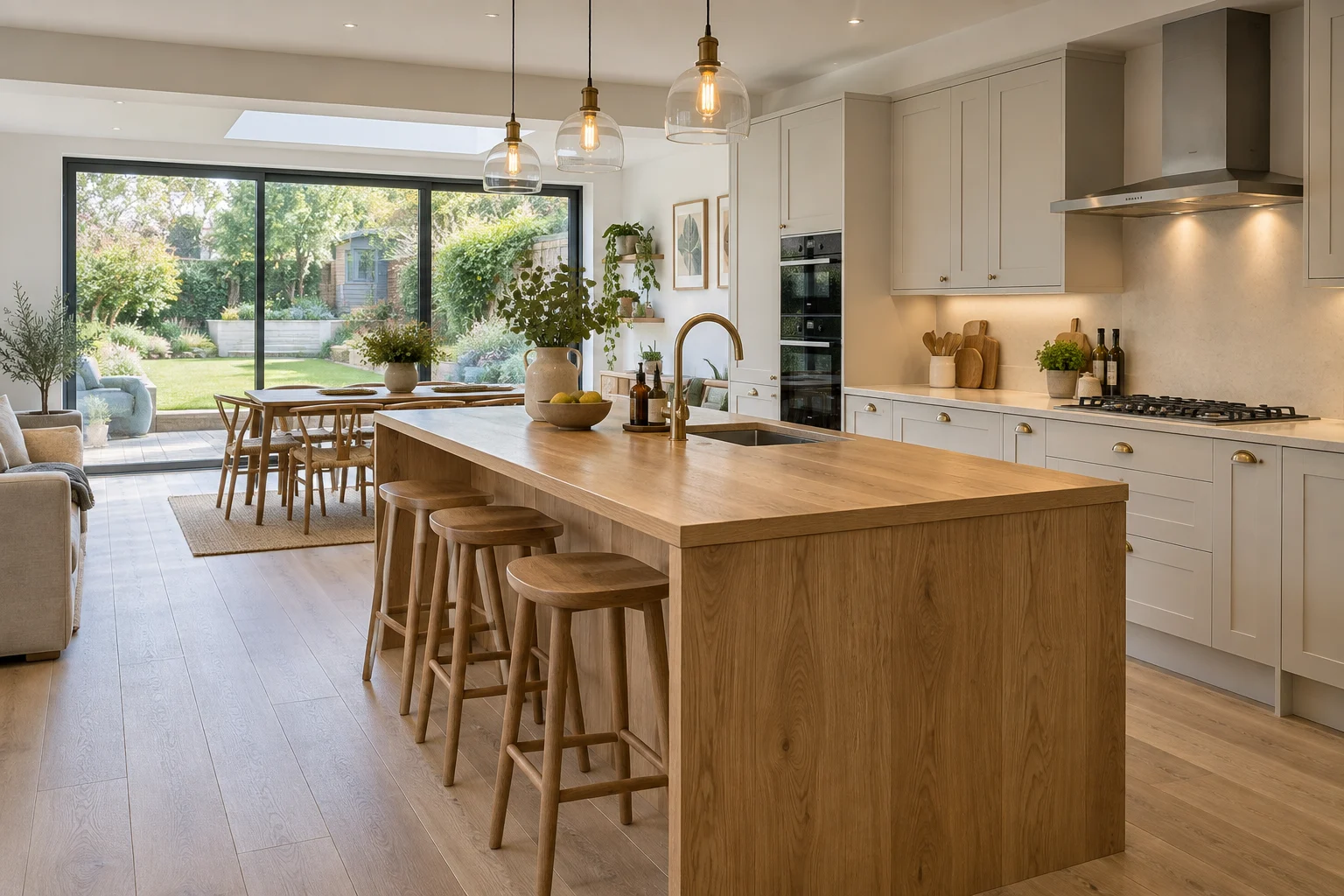
Architectural concept · not a completed company project
NOTTINGHAM · KITCHEN RENOVATION
Kitchen renovation in Nottingham, from layout to fitting
Plan the room around the kitchen you intend to use. Discuss cabinetry, supplier information, preparation, installation and adjoining finishes with Design N Build.
Prefer to send your project details?OUR PROCESS
How your home project
takes shape
Start with a conversation. Agree the scope, responsibilities and timing before the next stage begins.
Talk through your project01. Consultation
Share your postcode, priorities, photographs and any drawings.
02. Design & scope
Discuss the layout, specification and information needed to price the work.
03. Build planning
Agree the construction package, appointment terms and programme.
04. Completion
Review the agreed work, outstanding items and relevant handover records.
YOUR QUESTIONS
Frequently asked questions
From the first conversation to the agreed building work, here are some useful things to know.
Ask us on WhatsAppCan you coordinate with my kitchen supplier?
Provide the supplier’s plans, installation requirements and delivery expectations before the building scope is finalised. Cabinet dimensions, worktop templating and appliance connections can affect the sequence. We can discuss how preparation and installation responsibilities should be divided so neither party assumes the other is completing an essential item that has not been included in the price.
Should I order the kitchen before discussing building work?
It is sensible to coordinate the room and building requirements before committing to final dimensions. Wall removal, floor build-ups and service changes can affect the fit. An early discussion can establish what needs measuring or designing first, which decisions can proceed and where ordering too soon might create avoidable changes or storage requirements.
Can you move the sink or cooking area?
Relocation should be assessed against water, drainage, extraction and electrical requirements as well as the preferred appearance. Send the proposed arrangement so the service implications can be discussed before it is treated as fixed. The final quotation should describe the agreed routes and making-good, together with any specialist work or items supplied by others.
Can the kitchen renovation be combined with wall removal?
A combined scope can help coordinate the opening, structural work and new kitchen, but the wall must be assessed before demolition is agreed. We can discuss the intended layout and the need for design or engineering information. That allows the kitchen arrangement, structural supports and final finishes to be developed as connected parts of one project.
What is the difference between replacing units and renovating the kitchen?
Replacing units may retain the existing room and services. A renovation can also alter walls, lighting, floors, ventilation and plumbing. List each change you want so the building work and the kitchen-supplier package are defined together instead of being priced as interchangeable jobs.
How should appliance specifications be shared?
Send the actual model references and installation information when selected. Built-in dimensions, supplies and clearance requirements need coordination with cabinetry. Mark undecided appliances as provisional and agree when selections must be finalised before service positions and furniture are fixed.
More project questions 14 answers
What should I consider before adding an island?
Show the room dimensions, doors, appliance openings and the routes people use. Include stools or seating in the plan if wanted. An island should suit the available room and services; its size should not be selected independently from the circulation around it.
How is the worktop sequence planned?
Ask the supplier and installer when final measurement can take place and what must be ready first. Templating, manufacture and installation can create a gap between cabinet fitting and a usable kitchen. Agree temporary arrangements and confirm who coordinates the handover between suppliers.
Can existing flooring be retained?
Its condition and the revised unit layout need checking. Areas previously covered by cabinets may have a different finish or level. Agree repairs, protection and thresholds before assuming the visible floor can stay unchanged beneath a redesigned kitchen.
Where should kitchen sockets and lighting be planned?
Use the furniture and appliance layout to mark work areas, storage, switches and lighting intentions. Coordinate the electrical design with the relevant trade before plastering or fitting. Identify whether changes outside the kitchen are needed and include them in the scope discussion.
What should I ask about extraction?
Discuss the cooking position, appliance specification and possible route with the designer and installer. Cabinetry and external openings can affect the solution. Do not assume that an attractive hood or a supplier’s drawing establishes a suitable installation for the property.
Can I keep using the kitchen during the renovation?
Ask which facilities will be disconnected and when. Agree any temporary cooking, washing-up and refrigeration arrangements before work begins. Whether partial use is practical depends on the sequence and safety of the working area, not only the number of cabinets being replaced.
Who checks the final kitchen measurements?
Name the responsible supplier or surveyor in the agreed process. Clarify when the room is ready to measure and how changes to walls, floors or openings are communicated. Ordering from an early sketch can create problems if the finished room differs.
What belongs in a kitchen installation quotation?
Clarify removal, preparation, units, appliances, service connections, worktops, splashbacks, flooring and decoration. Distinguish supply from installation and identify specialist tasks. Check whether waste removal and work to adjoining areas are included rather than relying on a single kitchen fitting label.
How do I handle products that arrive damaged or late?
Agree responsibility for checking deliveries, reporting problems and arranging replacements. Keep the installer informed because missing items can affect templating and completion. The contract should explain the consequences of client-supplied products delaying work rather than leaving that discussion until delivery day.
Can a utility area be included in the same project?
Show both spaces and the appliances, storage and service requirements in each. A utility may change where laundry, cleaning equipment or overflow storage sits. Include connecting doors, finishes and service routes so it is priced as part of a coordinated scope.
What if the walls need more preparation after removal?
Existing finishes and hidden conditions may only become clear after stripping out. Ask how additional preparation will be assessed and agreed. Keep the distinction between a known allowance and newly discovered work clear before new cabinets or splashbacks conceal the area.
How can I compare kitchen renovation prices fairly?
Use the same room layout, product schedule and completion requirements. Separate cabinet supply from building work and compare allowances for worktops, services and finishes. A lower unit price says little about the total renovation if preparation and installation are excluded.
What should be demonstrated at kitchen handover?
Review the fitted layout, doors, drawers, worktops, appliances and controls against the agreed package. Request relevant installation information and record outstanding items. Keep supplier contacts and warranty documents together, particularly where products and installation came from different businesses.
What should I send for a kitchen renovation discussion?
Send the postcode, room photographs, approximate layout and supplier drawings if available. Explain what you want to keep and whether walls or services will move. Mention any products already ordered and the condition you expect at the end of the work.
A kitchen renovation built around the room you actually use
Start with the changes that matter at home
A kitchen renovation can change considerably more than the cupboard doors. It can resolve an awkward route through the room, provide somewhere to prepare food without clearing the dining table, or bring washing, cooking and storage into a layout that suits the household. Tell Design N Build which daily frustrations you want removed. A photograph of a kitchen you like is helpful, but it becomes a useful building brief when you explain what must work differently in your Nottingham home.
Separate the essential outcome from the preferred appearance. Perhaps the existing sink position is convenient but the work surface is too small. Perhaps the kitchen looks dated yet its main problem is a door opening across the cooking area. A list of practical priorities lets the room preparation, service alterations and furniture design develop together. It also makes it easier to protect the important parts of the project when comparing different specifications or deciding which optional items to leave until later.
Our kitchen project discussion starts with the property, the proposed room and the work you need included. You may already have chosen a supplier, or you may still be deciding whether the existing space is enough. Send the postcode, photographs and any kitchen plan on WhatsApp. Explain whether you want furniture replaced within the same layout, the room comprehensively renewed, or building alterations as part of a larger change. Those are different packages and should receive different scope discussions.
Distinguish a kitchen fit from a building package
Furniture installation generally follows a room layout and a set of product instructions. Building preparation may involve the condition of walls, ceilings and floors, changes to openings, revised services and making good. These responsibilities need to be identified before either contractor assumes the other has included them. A supplier's attractive visualisation can describe the intended furniture while leaving many of these construction interfaces unresolved. Use it to communicate the ambition, then establish the documents and decisions needed to make the ambition buildable.
There is no need to buy every element through one organisation for the work to be coordinated. What matters is that each item has a named supplier, installer and checking responsibility. For example, supplying a worktop is different from taking final measurements, providing the support it requires and connecting a sink once it is fitted. Ask for the appointment to distinguish these tasks. This makes the quotation more useful and gives the people involved a shared understanding of what has to happen before the room is ready.

Choose a layout before committing to furniture
Test the room with doors and appliances open
A plan should show more than cabinet rectangles. Mark the doors into the kitchen, any route to the garden, appliance doors and the position of dining chairs when someone is sitting in them. Consider who moves through the room while another person cooks. A layout that looks spacious in an empty image can feel restrictive when a dishwasher, drawer and back door need the same space. Describe these everyday situations to your kitchen designer before deciding that a particular arrangement is settled.
Avoid selecting an island solely because it is prominent in a reference image. Decide what the island would do: preparation, storage, seating, cooking or a combination. Each purpose changes the brief. Seating needs to be considered as an occupied part of the room, while an appliance creates service and installation requirements. If an island compromises the passage to a frequently used doorway, a peninsula or a different run of furniture may deserve comparison. The aim is a usable kitchen rather than a particular furniture label.
Think about where items arrive and where they are put away. Shopping, recycling, school bags, pet food and small appliances often expose gaps in a plan that otherwise contains plenty of cupboards. Identify the things that currently remain on the worktop because they have no convenient home. That information helps the designer allocate accessible storage and electrical provision. It can also prevent paying for a large amount of cabinetry that does not address the items your household actually needs to store.
Decide whether the room boundary must change
If the current kitchen cannot provide the required space, distinguish an internal layout change from an extension. Removing an internal wall may connect existing rooms but does not add floor area. Extending can create additional room, yet introduces a separate building scope and external design questions. Discuss these alternatives before finalising a furniture order. You can use our structural alterations and house extension pages to understand the different conversations, then bring the preferred option into one coordinated brief.
Keep a record of what should remain. An existing window, radiator, pantry, doorway or sentimental piece of furniture can strongly influence the new arrangement. If an item is a requirement, mark it on the drawing instead of expecting it to survive by default. Conversely, identify features you would be willing to change if they prevent the room working well. A clear distinction between fixed constraints and negotiable preferences gives the design process a more reliable starting point.
Make the supplier and building drawings agree
Work from one identified revision
A kitchen supplier may issue several versions of a layout as products and dimensions change. Make sure the construction discussion uses the version you intend to order. Include the date or revision reference and explain what remains provisional. A builder pricing an earlier arrangement may allow for services in positions that no longer correspond with the latest cabinetry. Keeping the current drawing set together helps everyone identify a change before it becomes a disagreement about the agreed installation.
A room measurement and a final furniture check are not interchangeable. The finished wall faces, floor level, openings and construction details may still be changing during a renovation. Establish when measurements can be relied on for ordering and who accepts responsibility for that check. Where a supplier requires a final site measurement, allow for it in the programme. Do not treat a preliminary dimension supplied for discussion as approval to manufacture a product that cannot readily be adjusted.
Product details belong alongside the drawing. Include actual model references for appliances, sinks, taps, extractors and other selected items. Two products of the same general type may have different space, connection or ventilation requirements. If a product is undecided, record that fact and agree a decision point. A quotation can explain an allowance or assumption, but the installation team should not have to discover an uncommunicated product change after positions and finishes have been fixed.
Give each interface an owner
Ask who checks the connection between the furniture design and the building work. The kitchen installer may need straight, prepared walls; the floor contractor may need cabinetry kept clear of a particular area; the worktop supplier may need base units fixed and accepted before measuring. These dependencies should become explicit handover points. They are more useful than a broad statement that everyone will coordinate later, particularly where you are purchasing different elements directly.
Client-supplied items should appear in the scope even when their purchase price sits outside the building quotation. Delivery, unloading, checking for damage, secure storage and replacement parts can affect the sequence. Agree what happens if an item arrives incomplete or does not match the approved specification. The purpose is to avoid a small supply problem holding up unrelated work or leaving you uncertain about whom to contact when the installation cannot proceed as planned.
Understand the preparation behind the finished kitchen
Inspect the surfaces that new finishes will depend on
Existing cabinets can conceal uneven plaster, unfinished floors, redundant pipes and earlier alterations. The visible condition of the room does not establish the condition of everything behind it. Ask how the quotation distinguishes known preparation from findings that can only be assessed after removal. This is especially important when changing the footprint of the furniture, because areas previously covered by units may become visible or need to support a different fitting.
Decide how much of the existing decoration and adjacent room finish is included. A new opening, moved socket or altered pipe route may affect surfaces outside the immediate cabinet run. The scope should identify whether making good ends at the repair, the wall, or the complete room. These distinctions can materially change the appearance of the finished project. They also make comparison between quotations fairer when one includes a full decorative finish and another includes only local preparation.
If you plan to keep a floor, check how it relates to the revised furniture arrangement. An old island footprint, exposed area beneath a removed unit or change at a threshold may need a specific solution. Retaining a surface should be an assessed decision, not an assumption made because it looks sound where it is currently visible. Discuss protection while other work takes place and clarify the extent of any repair or replacement included in the agreed package.
Coordinate floor build-ups and finished levels
The final floor level affects more than the material underfoot. It relates to appliance positions, door clearances, thresholds and the relationship between adjoining spaces. Share the proposed flooring specification with the people designing and fitting the kitchen. Where additional layers or preparation are anticipated, identify them before final dimensions are approved. A decision made late in the sequence can change the space available for an appliance or produce a junction that differs from the design you expected.
Floor finish preferences also affect how the project is scheduled. Ask the relevant suppliers what needs to be in place before their work and what protection is required afterwards. The answer may depend on the product and installation system rather than a universal rule about whether kitchens or floors always go first. Record the agreed sequence for your chosen materials. That gives the programme a practical basis and avoids treating an internet example as a specification for a different room.
Resolve water, drainage and cooking services together
Treat a moved sink as a route question
A sink shown in a new position implies water and waste connections as well as a different cabinet. The practical route may affect floors, walls and neighbouring rooms. Share the current arrangement and proposed position so the relevant installer can assess the implications. Ask the quotation to distinguish the fitting connection from any alteration of the route serving it. A drawing with a sink symbol does not by itself explain how the installation will connect to the property.
The same discipline applies to dishwashers, washing machines and other water-using appliances. Identify all the appliances that will be connected, including any being retained. Access for future maintenance should remain possible after the furniture is installed. Discuss where connections and isolation arrangements will be accessible with the appointed installer. This is a coordination task for the professional responsible for the installation, not something to improvise once the preferred furniture arrangement has occupied the available space.
If the kitchen is part of a wider refurbishment, tell us about other planned service work. You may be changing a utility room, moving heating equipment or renewing finishes above or below the kitchen. These works can share access requirements even when they are priced separately. Identifying them early helps the appointed team assess whether completing one item now would obstruct another later. It also helps you distinguish essential enabling work from optional improvements elsewhere in the house.
Specify cooking and extraction as connected decisions
The preferred cooking appliance, its position and the extraction arrangement should be reviewed together. A visually attractive hood may not establish the appropriate route or installation for the property. Provide the chosen product information and identify any constraints involving external walls, cupboards or neighbouring spaces. Ask the designer and relevant installer to confirm the proposed arrangement. Avoid treating a supplier's computer image as evidence that all technical and external-detail questions have already been resolved.
Where an appliance change requires different electrical or gas work, the scope must identify the appropriate competent trade and its responsibilities. Ask what assessment, connection, testing and documentation are included in that person's appointment. A kitchen building quotation should not suggest that every specialist connection is automatically covered merely because an appliance appears on the drawing. Confirm the package before purchase so the selected equipment and the agreed installation remain compatible.
Plan light and power around activities
Distinguish preparation light from atmosphere
A kitchen can need different lighting for chopping food, cleaning, eating and moving through the room at night. Tell the designer which activities happen in each part of the layout. Consider how cupboards, shelves and a person's position at the worktop affect the light reaching the surface. The electrical design should follow the room's use and the selected products. It should not be reduced to an arbitrary number of ceiling fittings chosen without reference to the furniture arrangement.
Think about the small appliances you use regularly and where they will stand. A coffee machine, mixer or charging point may have a preferred position that is not apparent from a drawing of built-in appliances. Share those preferences before electrical positions are finalised. The relevant installer can then assess an appropriate arrangement and explain any additional work required. This is more reliable than leaving every decision until the kitchen is ready to be fitted.
Consider control locations from the perspective of arriving and leaving. Which entrance will you normally use, and where will you want to switch off? If a kitchen connects with a new dining or family area, decide how those activities should relate without assuming they need identical lighting. Record the intended use in the brief and have the technical design coordinated by the responsible trade. Product selection, control preferences and installation responsibilities should all be visible before the scope is agreed.
Keep maintenance access in the finished design
Concealed lighting components and built-in equipment may require access for repair or replacement. Ask how that access will be retained without unnecessarily disturbing expensive finishes. A neat appearance should not depend on sealing every serviceable component permanently behind cabinetry. The appropriate detail depends on the product and location, so use the manufacturer's requirements and the installer's advice. Keep that information with the other kitchen documents for future reference.
Choose finishes with the installation in mind
Review samples at the right decision stage
Door finishes, worktops, flooring and wall surfaces interact with the room's light and the other materials retained in the house. Where possible, compare samples together in the intended space rather than approving each item from a separate screen image. A design preference can then be considered alongside cleaning, care and repair expectations. Ask each supplier for the information relevant to the specific product, particularly where a finish requires a maintenance routine you have not used before.
Worktop material influences measurement, manufacture, handling and the installation sequence. Clarify which cut-outs, edges, upstands and junctions are included in the supplier's price. A quotation for a surface area may not describe every finished detail. If you want a particular appearance at a window, return or seating edge, show it on the specification. The building and furniture packages can then be coordinated with an identified detail rather than an assumed finish.
Splashbacks and wall finishes need a similarly clear boundary. Decide which surfaces will be tiled, clad, painted or otherwise finished, and whether preparation is included. Identify how the finish meets sockets, worktops, cupboards and external corners. These are small areas of the overall project but are often directly in the homeowner's line of sight. Agreeing them early reduces the risk of a technically complete room that looks unfinished because its junctions were never described.
Control substitutions during supply changes
If a selected product becomes unavailable, a replacement should be checked against both the appearance and the installation. A similar-looking appliance, handle or fitting may not have identical dimensions or requirements. Confirm the substituted model before affected work continues. Keep a short record of what changed, why it changed and whether it affects the price or programme. This is particularly useful when several suppliers are communicating with different members of the household.
Prepare for living without a finished kitchen
Agree the disruption you can realistically manage
Before work begins, identify the facilities that will be removed or disconnected and the periods when they cannot be used. The programme should help you understand the sequence, while recognising that exact dates depend on the agreed work and findings. Do not assume a partly completed kitchen can remain an ordinary family workspace. Discuss alternative cooking, washing-up and food-storage arrangements with the household before relying on them, and keep the working area separate as directed by the site team.
Tell us about access restrictions that influence the installation. A narrow route, shared entrance, upper-floor kitchen or limited space for deliveries can affect how materials and furniture reach the room. Send photographs taken safely and describe the route from the unloading point. If arrangements involve shared property or access controlled by another party, identify who will obtain the necessary agreement. This allows practical logistics to be considered before delivery slots and fitting dates are treated as fixed.
Plan where items removed from the kitchen will go. Crockery, food, small appliances and furniture need a temporary home that does not obstruct the route used for the works. Confirm which existing appliances you intend to keep and which materials are to be removed as part of the package. Disposal responsibilities should be stated in the quotation. Leaving these decisions until the strip-out day can make an already disruptive stage more difficult than it needs to be.
Allow for the worktop and final-connection stage
A kitchen may look close to complete while still awaiting a manufactured worktop or final connections. Ask the supplier to explain the dependency between fitted units, final templating and manufacture. Build your household arrangements around that actual sequence. If a temporary facility is proposed, agree its scope and suitability explicitly. The visual presence of new cabinets should not be taken as confirmation that the room is ready for normal use.
Compare the complete renovation cost
Put the same package in front of each contractor
To compare quotations, separate furniture and appliances from building preparation, service alterations, installation, finishing and waste removal. Identify the items you are buying directly. Issue the same current plans and specification to each person pricing the work. A low installation figure may exclude work included in another proposal, so begin by comparing scope rather than treating headline totals as equivalent. Ask for unclear assumptions to be explained before selecting the appointment.
Where the condition behind existing fittings is unknown, the quotation should make that uncertainty visible. Ask how additional findings will be recorded, how a proposed response will be priced and how you will authorise it. This does not mean that every uncertainty must be resolved before an initial conversation. It means the eventual agreement should give you a clear decision process rather than leaving discoveries to informal assumptions about what was included.
Keep upgrades distinct from necessary work. A more expensive worktop, changed appliance or additional cabinet is a client choice, while an identified defect may need a separate assessment. Recording these as different decisions helps you understand the developing cost and protect the priorities established in the brief. Ask for applicable tax treatment, payment stages and any separately charged design or survey work to be stated in the written proposal.
Request the right next step from Design N Build
For a Nottingham kitchen renovation, send the property postcode, photographs of the existing room and the latest supplier drawing if available. Include the work outside the furniture package: floor replacement, new openings, service changes, decoration or adjoining-room alterations. State which products are chosen and which remain undecided. We can then discuss the information needed to define the building package and the appropriate next stage, rather than pretending a complete price can be inferred from a cabinet count.
Review the finished room before closing the project
Check the agreed details systematically
Use the specification and agreed drawings to review the completed work. Check the described finishes, cabinet operation, accessible storage, agreed connections and the condition of adjoining areas affected by the project. Ask the relevant installer to demonstrate equipment and explain maintenance information within their scope. Record outstanding items clearly and agree how they will be addressed. A written list is more useful than relying on a general impression that a few small things still need attention.
Collect supplier instructions, product details and applicable installation records in one place. Knowing the exact model and responsible supplier can save time when a replacement component is needed later. Clarify the contact route for a question about furniture, a worktop or building work, because these may belong to different appointments. The handover should leave you with a usable room and an understandable set of responsibilities, not only a collection of receipts.
After you begin using the kitchen, you may identify a question about a setting or a detail that was not obvious during the demonstration. Use the agreed aftercare contact and describe the issue precisely, with photographs where helpful. Distinguish a product-use question from a change you would now like made to the design. The relevant contract and product terms determine the response; a general web page should not substitute for the terms supplied for your actual renovation.
Resolve the details that commonly fall between quotations
A practical room-by-room pricing record
Prepare a simple written record for each wall or run of kitchen furniture. Describe the cupboards or appliances proposed there, the visible finish behind them and the work needed before they can be fitted. Mark the existing items that remain. This turns a broad request to renovate the kitchen into something the suppliers can check against their own proposals. It is particularly helpful when you are comparing a supply-only furniture quotation with a contractor's building estimate, because the two documents describe different parts of the same outcome.
For an existing kitchen with a retained utility connection, identify whether the utility remains operational while the main room is changed. A retained appliance may still depend on a route that passes through the working area. Ask the appointed installer to review that dependency rather than treating the utility as automatically unaffected. If both rooms are included in the project, separate their finish schedules. A practical utility specification does not need to duplicate the kitchen's premium finishes unless that is what you intend to purchase.
A changed opening can affect the position of tall cupboards and the visual balance of a furniture run. If structural alterations are proposed, bring the kitchen drawing into the discussion before the opening dimensions are settled. Equally, do not move a structural line solely to match a furniture image without the appropriate design assessment. The kitchen plan and the building design need a coordinated answer. Our structural alterations page explains the information needed for that part of the enquiry, while this page keeps the focus on making the completed kitchen fit and function.
Check what the delivery date actually means
A supplier's delivery date is not necessarily the date when every component needed for completion is available. Check the list of ordered items, including panels, trims, handles and accessories that may be supplied separately. Agree who checks the delivery against that list and how missing or damaged items will be reported. If you accept a delivery yourself, keep the relevant paperwork and follow the supplier's checking instructions. Do not assume that a stack of unopened packages means the installation team has everything required to finish the room.
Think about storage conditions before arranging an early delivery. A product may have specific requirements for handling and storage, and the renovation area may not yet be suitable. Ask the supplier what those requirements are and identify a practical agreed location. The building contractor should know whether space is being reserved for stored furniture or appliances. Otherwise the area needed for work or safe access can become occupied by items that arrived before the room was ready to receive them.
Make optional work easy to decide
If you are considering several upgrades, ask for them to be identifiable rather than hidden within a single changing total. Examples might include an additional furniture run, an alternative wall finish or work extending into the dining area. Explain which option is your preferred baseline. That gives you a meaningful comparison when reviewing the proposal and prevents a later discussion from confusing work you selected with work that was merely explored. Once an option is accepted, update the specification so there is one agreed description of the kitchen to be delivered.
Bring these records to the project discussion with your postcode and current drawings. You do not need to prepare a professional construction specification yourself; the purpose is to make your decisions and supplier commitments visible. Design N Build can discuss the building package against that information and explain what remains to be assessed before an appointment or quotation is confirmed. Call the team or send the documents on WhatsApp when you are ready to connect the kitchen design with the work required in your home.
Price the retained kitchen alongside the new fittings
Map the items staying in the existing room
Before requesting installation prices, mark which kitchen items remain in use or stay in place. Existing flooring, a retained appliance, a decorated wall or a working radiator can influence removal and preparation. Explain their condition and the final appearance you expect around them. A supplier’s new furniture plan may not show those obligations. The renovation proposal should identify the protection, connection and making-good work required at each retained item, rather than describing everything outside the new cabinets as an undefined existing condition.
If you intend to reuse equipment, obtain its relevant product information and discuss compatibility with the proposed layout through the appropriate installer. An appliance that fits the current room may need a different connection or housing in the new arrangement. Record who checks that point before installation. Where the existing item is unsuitable or a condition remains unknown, agree the decision route and how any replacement affects the price. This makes a retained-product choice part of an informed purchasing scope instead of assuming that reuse always reduces work.
Agree removal, salvage and final finish boundaries
Tell the contractor whether removed cabinets or fittings are to be disposed of, retained by you or moved elsewhere. Identify the location for agreed salvage and the party responsible for collecting it. This can affect handling and storage, so it belongs in the scope. Do not assume that an installer will preserve every old component during removal unless that task has been accepted and assessed. The purchasing discussion should state the intended outcome and any limitations, with the preparation of the room described separately from the delivery and fitting of new goods.
Review the finish boundary above, below and beside the new furniture. A new cabinet arrangement may expose areas previously hidden, and a changed worktop can alter the visible wall surface. Decide which preparation, decoration or tiling belongs to the contractor and which will be completed under another appointment. Ask for the quotation to name these areas, using the actual retained-room condition where known. It gives the homeowner a practical view of the completed renovation, while preventing the final appearance from being judged against an unstated expectation that the whole room would be renewed.
LET’S TALK ABOUT YOUR HOME
Ready to improve your home?
Let’s talk.
Call us for an initial conversation, or send your postcode, photos and drawings on WhatsApp. We’ll help you work out the next step.